

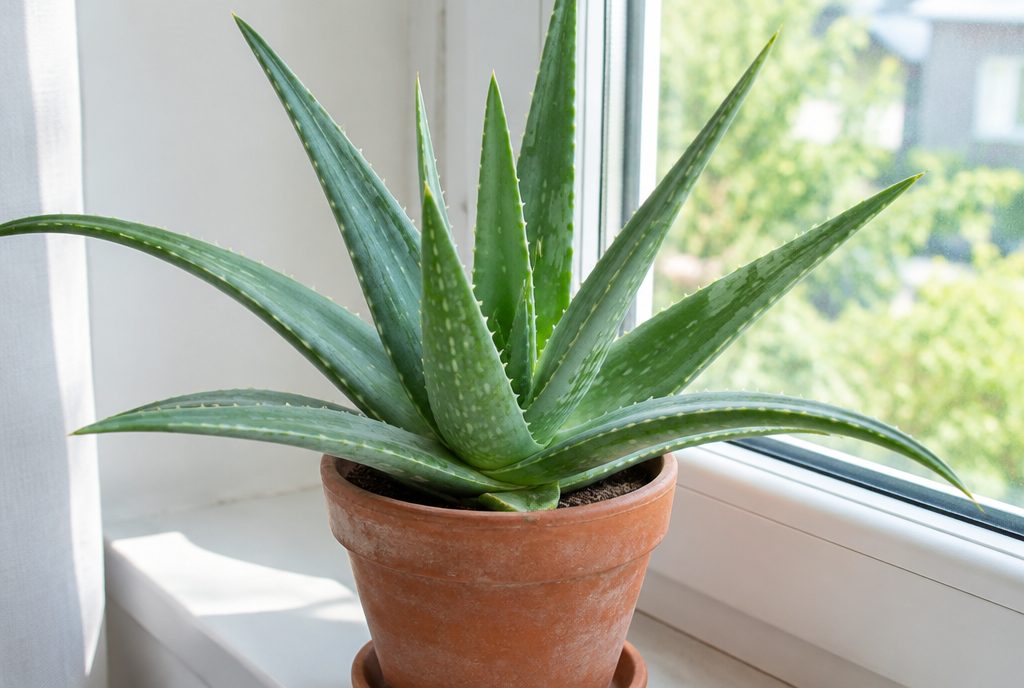
Aloe vera is a succulent houseplant that wants a sunny window, a coarse well-draining mix and watering that errs on the dry side. Penn State puts it plainly: as with all succulents, it is best to err on the side of underwatering. Indoors it lives happily near a sunny window, and it is not frost tolerant, so it comes inside before cold weather. The ASPCA lists aloe as toxic to dogs and toxic to cats, which matters if your pets chew plants.
Light
Penn State says that when growing indoors, place aloe near sunny windows so it can receive full sun to bright indirect light. NC State says to grow it in full sun to partial shade, in very well-drained soil suitable for succulents. Penn State also suggests periodically rotating the container so all sides of the plant receive adequate light.
UF/IFAS adds a caution: make any move gradual, because the plant can sunburn when moved from low to bright light too quickly. That applies when you put a houseplant outdoors for the summer or shift it to a sunnier window.
Water
The three extension sources agree on the principle and differ on the detail.
NC State
UF/IFAS
Penn State
The conflict is how dry is dry: completely (NC State), the top inch (UF/IFAS) or the surface (Penn State). A cautious route is to follow NC State, the driest rule, and to water less in winter as Penn State says. All three warn against standing water, and Penn State says aloes are extremely drought tolerant and susceptible to root rot, so never allow the plant to sit in water.
Temperature and humidity
Penn State says aloes are not frost tolerant, so you must take them indoors before the threat of frost. UF/IFAS says an indoor aloe can be moved outside in summer and can be grown outside year-round in zones 8 to 11, while NC State says it can be an outdoor perennial in zones 10 and higher. That is another conflict between the sources, so if you are on the edge, treat zone 10 as the safer reading. Our sources give no humidity range and no minimum indoor temperature, so we do not give one.
Soil and repotting
Penn State says aloes prefer a coarse, well-draining potting mix. You can buy a cactus or succulent mix or make your own by mixing one part potting soil, one part sand and one part perlite or lava rocks. UF/IFAS says aloe can be grown in any well-drained quality potting media. NC State says the pot should have several drainage holes and that clay is best.
Penn State says replanting your aloe every two years can help refresh the soil and reduce crowding of the roots. UF/IFAS says to repot as needed to refresh the media or give the plant room to grow, and not to increase the new pot by more than two pot sizes, because too large a container can hold too much moisture and lead to root rot. Our aloe repotting guide has the details.
Growing season and dormant season
Penn State splits the year in two. The growing season runs from early spring to early fall, when you water thoroughly once the soil surface is dry. The dormant period, from fall through winter, calls for less water so the soil is barely moist, but not so little that the leaves shrivel. The shriveling leaf is Penn State’s warning sign that you have gone too far the other way. The other sources do not name seasons, so Penn State is the only one to follow for the calendar.
If you move the plant outdoors for summer, as UF/IFAS says you can, remember the sunburn warning and the frost warning together: bring it out into brighter light gradually, and bring it back in before frost (Penn State).
Pots and drainage
Aloe is a plant where the pot matters nearly as much as the soil. NC State says the pot should have several drainage holes and that clay is best. UF/IFAS warns against too large a container, saying not to go up more than two pot sizes because the extra soil can hold too much moisture and lead to root rot. Penn State says that aloes are susceptible to root rot, so the pot, the mix and the watering all have the same job: keep the roots from sitting wet.
A simple routine
- Put it by a sunny window. Full sun to bright indirect light indoors (Penn State). Rotate the pot now and then so all sides get light.
- Water only when the soil is dry. Completely dry (NC State), top inch dry (UF/IFAS), or surface dry in the growing season (Penn State). Never leave it standing in water.
- Cut back in fall and winter. The soil should be barely moist and the leaves should not shrivel (Penn State).
- Repot every couple of years. Penn State says every two years can refresh the soil and reduce crowding. UF/IFAS says as needed.
- Bring it in before frost. Aloe is not frost tolerant (Penn State).
Feeding
Our sources do not give a fertilizer schedule for aloe, so we do not give one. If you want to feed it, follow the label on a product made for succulents and ask your state extension office.
Propagation
Penn State says some aloes produce pups or offsets, which may be removed from the mother plant and transplanted into another pot. NC State says propagation can be done by division and that the plant spreads by offsets. Our aloe pups guide covers it.
Common aloe vera problems
NC State says mealybugs and aphids are insects that may affect the health of your aloe, and lists scale, leaf spot, aloe rust and sooty mold as diseases. Our sources give no treatments.
Pets
The ASPCA lists aloe as toxic to dogs and toxic to cats. Our aloe vera pet safety page reports the exact wording, the toxic principles and the clinical signs it lists, and what to do if a pet chews a leaf.
Size and flowering
NC State says aloe will grow 2 to 3 feet tall and spread by offsets. Penn State says it can grow over 2 feet, and UF/IFAS says about 2 feet. Indoors, UF/IFAS says plants will rarely bloom, and NC State and Penn State say flowers appear only on mature plants.
What our sources do not tell you
Our sources give no humidity range, no fertilizer schedule and no minimum indoor temperature. They also do not describe how to use the plant’s gel, and we do not cover that here. If a detail matters and is missing, ask your state extension office.
Grow these next
If you like a low-water plant, the snake plant is another that likes the soil to dry out between waterings. For something that trails from a shelf, try pothos.
More houseplant care guides
For side-by-side comparisons across all our plants, see how often to water houseplants, repotting houseplants, low-light plants and which houseplants are safe for pets.
Frequently asked questions
How often should I water an aloe vera plant?
The sources differ. NC State says to let the soil dry completely between waterings. UF/IFAS says to water when the top inch is dry. Penn State says to water thoroughly when the soil surface is dry during the growing season and to cut back in fall and winter. All of them say not to let it sit in water.
How much light does an aloe vera plant need?
Penn State says to place it near sunny windows so it gets full sun to bright indirect light. NC State says full sun to partial shade. UF/IFAS warns that it can sunburn if moved from low to bright light too quickly.
Is aloe vera toxic to cats and dogs?
The ASPCA lists aloe as toxic to dogs and toxic to cats, naming saponins and anthraquinones as the toxic principles. Our pet safety page has the exact wording.
What soil is best for aloe vera?
Penn State says aloes prefer a coarse, well-draining potting mix, such as a cactus or succulent mix, or one part potting soil, one part sand and one part perlite or lava rock.
How do I get new aloe plants?
Penn State says some aloes produce pups or offsets that can be removed and potted, and NC State says propagation can be done by division. Our propagation guide covers both.
Sources
- Aloe vera, NC State Extension Plant Toolbox
- Aloe: A Hardy Houseplant, Penn State Extension
- Aloe Vera, University of Florida IFAS Gardening Solutions
- Aloe, ASPCA Animal Poison Control
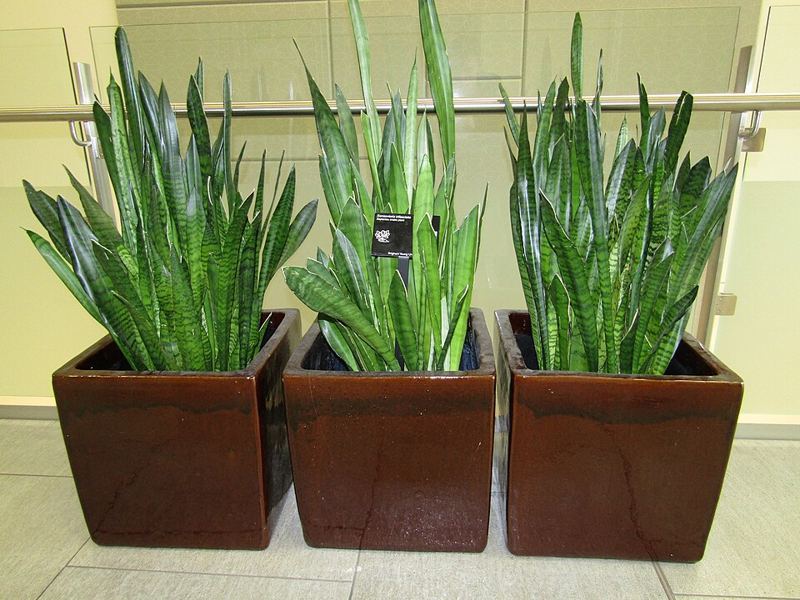 Snake Plant
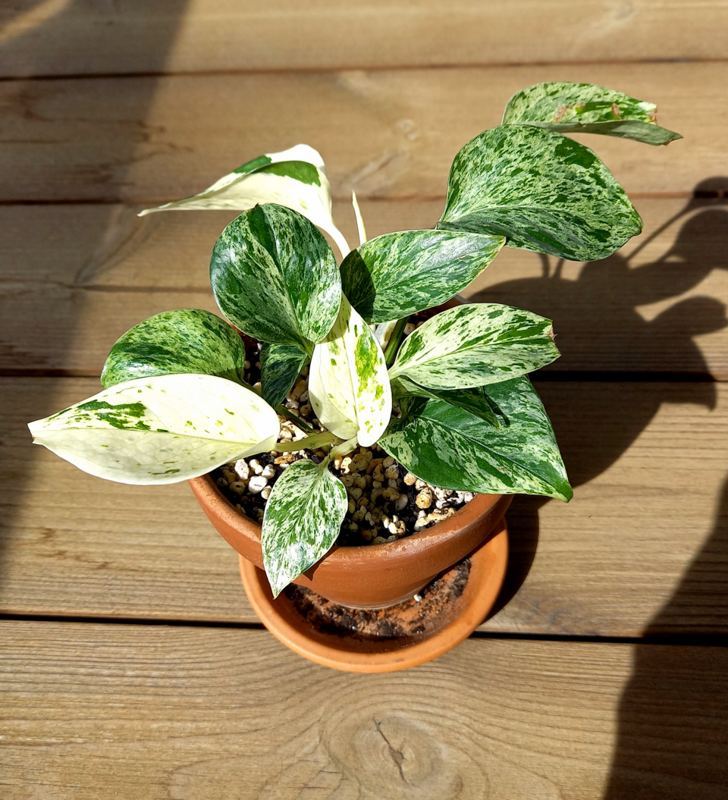 Pothos