

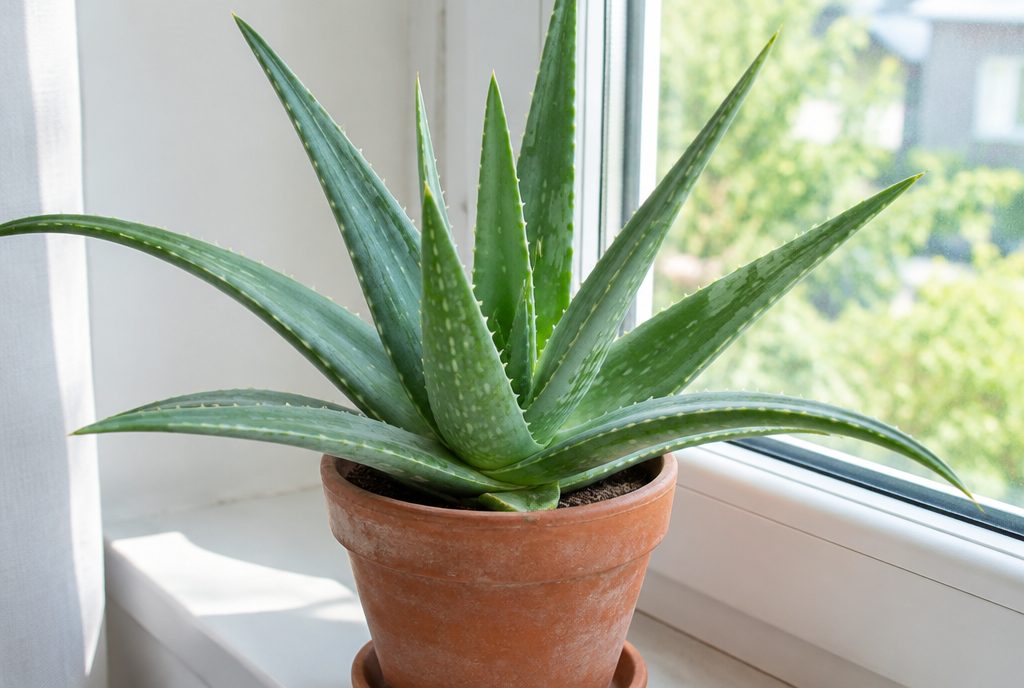
Repot aloe vera about every two years into a slightly larger pot with several drainage holes, using a coarse, fast-draining mix. Penn State says replanting every two years refreshes the soil and reduces crowding of the roots. UF/IFAS says to repot as needed and warns against a pot that is too big. This page sits under our aloe vera care guide.
How often to repot
Penn State says replanting your aloe every two years can help refresh the soil and reduce crowding of the roots. UF/IFAS gives a looser rule: the plant should be repotted as needed to refresh the media or to give the plant room to grow. These fit together. Two years is a sensible default, and a crowded pot is a reason to go sooner.
The sources do not name a season for repotting. Penn State describes early spring to early fall as the growing season, and we would lean on that, but it is our inference.
Choosing the pot
Drainage (NC State)
Size (UF/IFAS)
Size (Penn State)
The throughline is moisture. Penn State says aloes are extremely drought tolerant and are susceptible to root rot, so never allow the plant to sit in water. A pot with holes, a clay material that NC State prefers and a modest size jump all point to the same goal, which is keeping extra water away from the roots. If you use a saucer, empty it after watering.
Signs it is time
Penn State’s reason for repotting is practical: refreshing the soil and reducing crowding of the roots. UF/IFAS adds that the plant needs room to grow. A plant that has filled its pot, or whose soil has been in place for a couple of years, is due. Aloe spreads by offsets (NC State), so a pot that has gone from one rosette to a cluster is often the clearest sign. Our sources do not describe other symptoms, such as roots at the drainage holes, so we leave them out.
Choosing the soil
Penn State says aloes prefer a coarse, well-draining potting mix. You can buy a cactus or succulent mix, or make your own by mixing one part potting soil, one part sand and one part perlite or lava rocks. NC State says to grow aloe in very well-drained soil suitable for succulents. UF/IFAS says aloe can be grown in any well-drained quality potting media. So the recipe varies, but the requirement does not: it must drain quickly.
Repotting step by step
- Choose a pot one step up, with several drainage holes. Not more than two pot sizes bigger (UF/IFAS). Clay is best (NC State).
- Mix or buy a coarse, well-draining mix. A cactus or succulent mix, or equal parts potting soil, sand and perlite or lava rock (Penn State).
- Move the plant and refresh the soil. Penn State says replanting refreshes the soil and reduces crowding.
- Water carefully afterward. Let the soil dry between waterings (NC State), and never let the plant sit in water (Penn State, UF/IFAS).
- Place it near a sunny window. Full sun to bright indirect light indoors (Penn State). Make any move to brighter light gradual (UF/IFAS).
If you move the plant outdoors
UF/IFAS says an indoor aloe can be moved outside in summer, and Penn State says it must come back indoors before the threat of frost. If your aloe spends the summer outside, repotting before the move or after you bring it back are both reasonable, though the sources do not say which is better. In either case, keep the new pot’s drainage in mind, since rain can add water you do not control.
Pups at repotting time
Repotting is also when you meet the pups. Penn State says offsets may be removed from the mother plant and transplanted into another pot, and NC State says the plant spreads by offsets. Our propagation guide covers what the sources say.
What our sources do not tell you
Our sources do not give an exact pot diameter ratio, a best season for repotting, advice on how to handle root rot found at repotting or whether to water right after repotting. They also give no fertilizer advice for aloe. Pets matter at repotting time too: the ASPCA lists aloe as toxic to dogs and cats, so keep soil, roots and offcuts out of their reach (see our pet safety page). Back to the aloe vera care guide.
Frequently asked questions
How often should I repot aloe vera?
Penn State says replanting every two years can help refresh the soil and reduce crowding of the roots. UF/IFAS says to repot as needed to refresh the media or give the plant room to grow.
What size pot does aloe vera need?
Penn State says into a slightly larger container. UF/IFAS says not to increase the new pot by more than two pot sizes, because too large a container can hold too much moisture and lead to root rot.
What soil mix is best for aloe vera?
Penn State says a coarse, well-draining mix: a cactus or succulent mix, or one part potting soil, one part sand and one part perlite or lava rock. UF/IFAS says any well-drained quality potting media.
What kind of pot is best for aloe?
NC State says the pot should have several drainage holes and that clay is best.
Sources
- Aloe: A Hardy Houseplant, Penn State Extension
- Aloe Vera, University of Florida IFAS Gardening Solutions
- Aloe vera, NC State Extension Plant Toolbox