

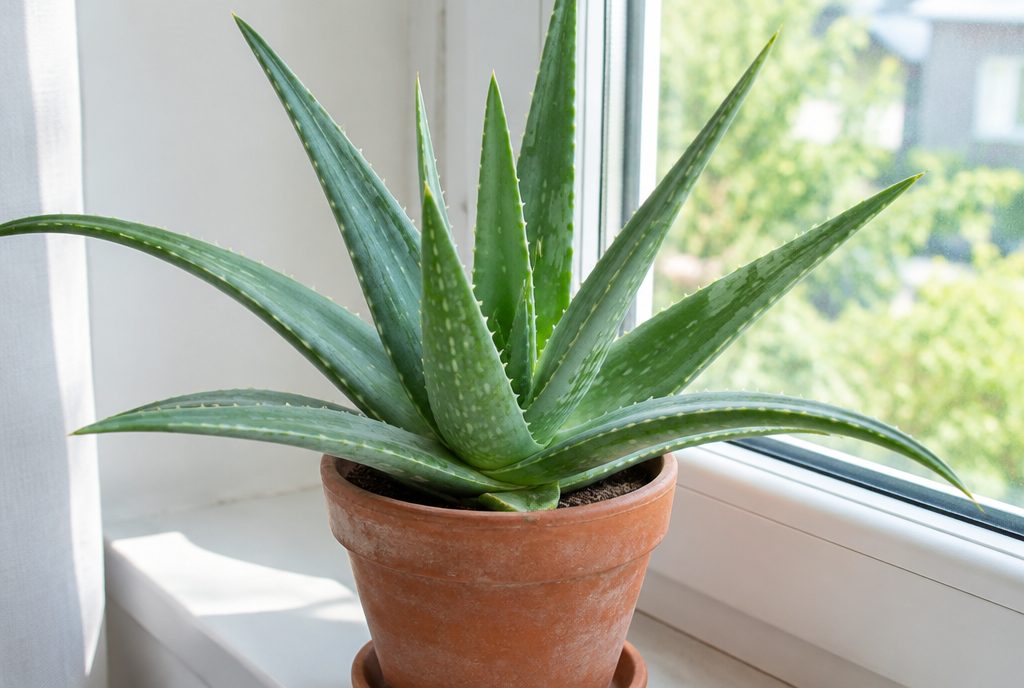
Aloe vera makes more of itself: the sources describe removing pups (also called offsets) from the mother plant and potting them, or dividing the plant. NC State says propagation can be done by division and that the plant spreads by offsets, and Penn State says the pups may be removed and transplanted into another pot. This guide sits under our aloe vera care guide and keeps to those sources. They are short, so we also say where they stop.
What pups and offsets are
Penn State says some aloes will produce pups or offsets. NC State says aloe will grow 2 to 3 feet tall and spread by offsets. In other words, the new plants grow beside the mother plant instead of from a seed or a leaf. That is why division and offset removal are two descriptions of closely related jobs.
Removing and potting a pup
Penn State says the offsets may be removed from the mother plant and transplanted into another pot. That is the whole instruction in the source. Here is how to apply it using what our sources say about aloe care.
- Choose a pup next to the mother plant. Penn State describes pups and offsets as removable from the mother plant.
- Separate it and pot it up. Penn State says to transplant it into another pot. The sources do not say how large a pup should be or how to cut it free.
- Use a coarse, well-draining mix. Penn State suggests a cactus or succulent mix, or one part potting soil, one part sand and one part perlite or lava rock.
- Pick a pot with drainage. NC State says the pot should have several drainage holes, and that clay is best.
- Water carefully. All three extension sources warn against letting aloe sit in water. NC State says to let the soil dry completely between waterings, and UF/IFAS says to water when the top inch is dry.
Division
NC State says propagation can be done by division. The sources give no steps for division. It follows from the way aloe grows that a clump with several offsets could be taken out of its pot and separated into sections, and repotting is the obvious moment to do it. Penn State says replanting your aloe every two years can help refresh the soil and reduce crowding of the roots, and UF/IFAS says to repot as needed to refresh the media or give the plant room to grow. Our repotting guide covers pot size.
When to do it
Our sources do not say what time of year to remove pups. Penn State does describe the aloe’s growing season as early spring to early fall and the dormant period as fall through winter, with less water in the dormant months. It is a reasonable guess that active growth is the kinder time to disturb a plant, but we are guessing, and the sources do not say.
How big does the mother plant get?
Knowing the size helps you decide when a clump is crowded. NC State says aloe will grow 2 to 3 feet tall and spread by offsets, Penn State says it can grow over 2 feet, and UF/IFAS says about two feet. A plant of that size in a modest pot will fill it, which is when pups tend to be noticed and when Penn State’s two-year repotting rhythm brings the plant out of its container.
Caring for new plants
Light: Penn State says full sun to bright indirect light when grown indoors near sunny windows. UF/IFAS warns that the plant can sunburn when moved from low to bright light too quickly, so bring a young plant up to a bright window gradually. Water: reduce the amount in fall and winter, so the soil is barely moist and the leaves do not shrivel (Penn State).
Pets and propagation
The ASPCA lists aloe as toxic to dogs and toxic to cats. Pups, offcuts and any plant material from propagation are the same plant, so keep them away from pets while you work. Our pet safety page has the details.
What our sources do not tell you
Our sources do not describe leaf cuttings for aloe, how big a pup must be, how long pups take to root, whether to let a pup dry before planting or how to handle the cut. If you want a step-by-step, ask your state extension office or a master gardener helpline. For everything else, go back to the aloe vera care guide.
Frequently asked questions
How do I propagate aloe vera?
NC State says propagation can be done by division. Penn State says some aloes produce pups or offsets, which may be removed from the mother plant and transplanted into another pot.
What are aloe pups?
Penn State uses the terms pups and offsets for the small plants some aloes produce next to the mother plant. NC State says aloe spreads by offsets.
What soil should aloe pups go into?
Penn State says aloes prefer a coarse, well-draining potting mix, such as a cactus or succulent mix. NC State says very well-drained soil suitable for succulents.
Can I propagate aloe from a leaf cutting?
Our sources do not describe leaf cuttings for aloe. They describe pups, offsets and division.
Sources
- Aloe: A Hardy Houseplant, Penn State Extension
- Aloe vera, NC State Extension Plant Toolbox
- Aloe Vera, University of Florida IFAS Gardening Solutions