

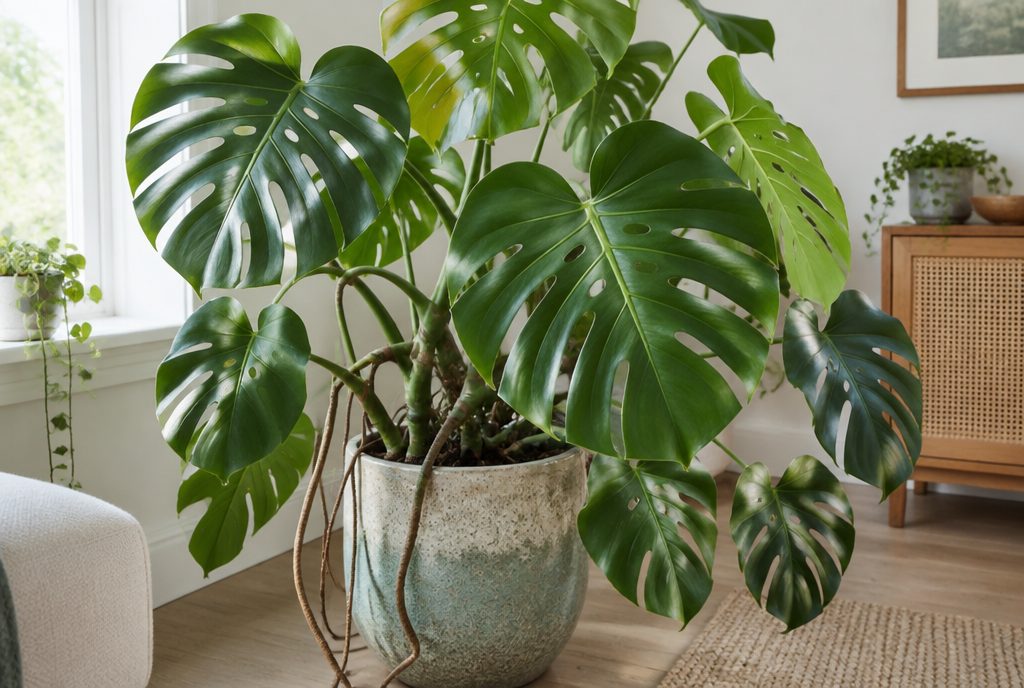
The sourced way to propagate a monstera is stem cuttings or air layering: Wisconsin Extension says to cut the tip of the stem just below an aerial root and pot the cutting, and Penn State says air layering or stem cuttings are the easiest methods. Wisconsin says you can do this at any time of year. That is the extent of the method in our sources. They give no cutting length, rooting medium, temperature or timeline. This page covers what is sourced and how to care for the new plant. It supports our main monstera care guide.
What the sources say
Wisconsin Extension gives the fullest statement: “Propagate from stem cuttings from mature plants or by air layering or simple layering any time of the year.” It adds: “Cut the tip of the stem just below an aerial root and pot the cutting.” Penn State says: “Monstera is propagated most easily through air layering or stem cuttings.”
NC State’s profile of the plant does not list a propagation method.
Putting the two sources together gives this picture:
- Stem cuttings from mature plants are the main method, named by both.
- Air layering is named by both, as the easiest alongside cuttings (Penn State).
- Simple layering is named by Wisconsin only.
- Season: any time of year (Wisconsin).
- Where to cut: the tip of a stem, just below an aerial root (Wisconsin).
The aerial root
An aerial root is one of the thin brown roots a monstera sends out from its stem above the soil. They are visible on the plant in the photo above. Wisconsin uses them as a landmark: cut just below one. The sources do not explain why. Our reading is that a cutting with an aerial root already has a start on roots, but that is our inference, not a statement from the page.
Wisconsin also says that aerial roots should be given “a tree bark or strong, moss-covered support sunk into the pot” to attach to, and that the moss-covered support should be watered so the roots can obtain water and nutrients. That is advice for the adult plant, covered in our containers and support guide.
What the sources do not say
- how long the cutting should be, or how many leaves it should have
- whether to root in water, moss or a potting mix, though Wisconsin says to pot the cutting
- how to do an air layer or a simple layer, which are named but not described
- the temperature or humidity that helps roots form
- how long rooting takes
- whether to use rooting hormone
If you need those details, look for a state extension guide that gives them. We will not fill them in from memory.
Caring for the new plant
Wisconsin says to pot the cutting. After that the care for the adult plant is the best guide we have, though the sources do not tell you whether a young plant should be treated differently.
- Light: bright light but not direct sun (Penn State), moderate brightness (NC State).
- Water: water thoroughly, then let the top part of the soil dry (NC State, Penn State). Overwatering can result in root rot (Penn State).
- Soil: a well-draining soilless potting mix rich in organic matter (Penn State), or a fertile soilless mix (Wisconsin).
- Humidity: preferably above 50% (Penn State).
- Temperature: 60 to 85°F (NC State). Growth stops below 50°F (Wisconsin).
Pets and sap
The ASPCA lists the Swiss cheese plant as toxic to dogs and cats, with insoluble calcium oxalates as the toxic principle, and Penn State says all parts are toxic to humans and pets if ingested. A cutting is plant material, so keep trimmings away from pets. Our monstera pet-safety guide has the wording.
Why propagate
Penn State says a monstera will reach 6 to 8 feet indoors and need something sturdy to climb. NC State says the same size. A tall plant that has outgrown its space is the usual reason to take a cutting. Our sources do not link pruning or height to propagation, so that is our observation, not theirs.
How this compares with other plants
For another plant with sourced detail, see our ZZ plant propagation guide, where division is the fastest method. For plants where the sources name methods but give no steps, see the rubber plant guide and the fiddle leaf fig guide. Those plants may or may not follow the monstera pattern, and we do not suggest copying it.
What our sources do not tell you
We have no sourced cutting length, rooting medium, hormone advice, air-layering steps or timeline. Back to the monstera care guide for light, water and the pet wording.
Frequently asked questions
How do you propagate a monstera?
Wisconsin Extension says to propagate from stem cuttings from mature plants, or by air layering or simple layering, at any time of year. It says to cut the tip of the stem just below an aerial root and pot the cutting. Penn State says air layering or stem cuttings are easiest.
When is the best time to take monstera cuttings?
Wisconsin Extension says any time of the year. NC State and Penn State give no season.
Where do you cut a monstera stem?
Wisconsin Extension says to cut the tip of the stem just below an aerial root. It gives no length.
How long do monstera cuttings take to root?
Our sources give no timeline, rooting medium or temperature.
Sources
- Swiss-Cheese Plant, Monstera deliciosa, University of Wisconsin Horticulture Extension
- Monstera as a Houseplant, Penn State Extension
- Swiss Cheese Plant (Monstera deliciosa), NC State Extension Plant Toolbox