

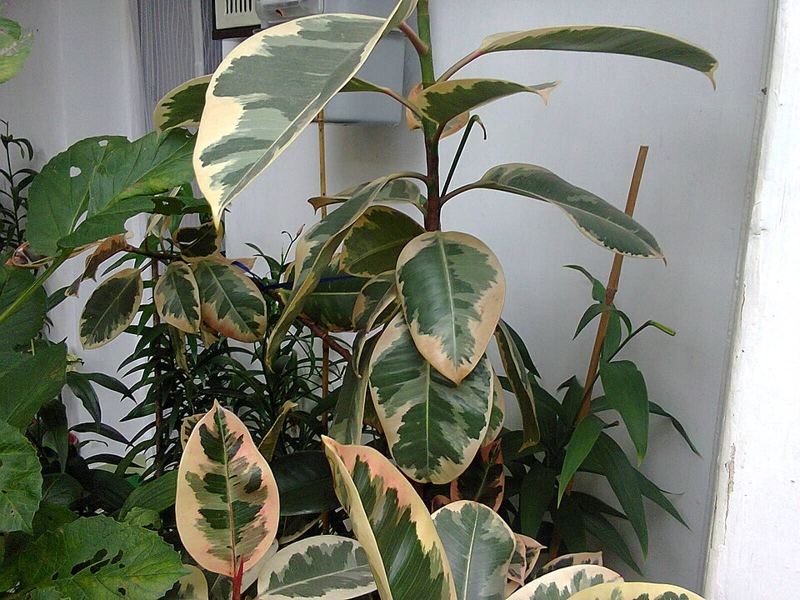
You can propagate a rubber plant by cuttings or air layering, according to Texas A&M, and NC State lists layering, root cuttings and seed. That is as far as our sources go. Neither gives a rooting medium, a temperature, a timeline or a cutting length. This page tells you what is sourced, what is not, and how the methods compare, and it sits under our main rubber plant care guide.
We would rather give you a short, accurate answer than a ten-step method nobody can cite.
The methods the sources name
NC State’s plant profile gives one line for propagation: “Layering, Root Cutting, Seed.” Texas A&M’s reference guide for foliage plants says “Air layering and cuttings.” Put together, four approaches appear:
- Cuttings. Named by Texas A&M. NC State’s “root cutting” may be the same idea or may mean a cutting taken from a root, and the page does not say which.
- Layering. Named by NC State, with no detail.
- Air layering. Named by Texas A&M. This is a way of rooting a stem while it is still attached to the parent plant. Our sources do not describe it, so we will not.
- Seed. Named by NC State. The same page says the plant “rarely flowers” indoors, so a houseplant will not give you seed in the ordinary course of things.
For most home growers the practical choices are therefore a cutting or an air layer. Which is better for a given plant is not something these sources settle.
What the sources do not say
Be clear about the gaps before you search elsewhere. Neither NC State nor Texas A&M tells you:
- how long a cutting should be, or where on the stem to cut
- whether to use rooting hormone, water or a potting mix
- the temperature or humidity that helps roots form
- how long roots take to appear
- what to do with the white sap, or whether it is an irritant
We could not find the sap question answered for Ficus elastica in these pages, so we say nothing about it. If you do take a cutting, wash your hands afterward and keep pets and children away from the cut material, which is ordinary housekeeping rather than a sourced claim.
Why take a cutting at all?
NC State says you can prune the main branches to make the plant bushier, or leave them alone for a tall, narrow shape, and that it is usually kept to 2 to 10 feet “with training or support as needed.” A plant that has outgrown its room is the usual reason people reach for propagation. That is our observation, not a source’s. The sources do not tie pruning to propagation, so we do not claim that a pruned stem is the right cutting.
Caring for the new plant
Once a cutting or layer has become a plant, the sourced care for the parent applies. NC State says to grow it in a soil-based potting mix under bright indirect light or partial shade and to protect it from afternoon sun. It should stay above 55°F, and it does not do well with drafts or cold. Water regularly, avoid overwatering, and cut back in the dormant months from fall to late winter. Our care card and light guide give the full picture, and the containers guide covers soil and pot choice.
Nothing in our sources says that a young plant needs different care from a mature one. Check the pot more often than you think you need to, since a small root ball has less to hold water, but treat that as common sense, not citation.
How a better-documented plant compares
If you want to see what a step-by-step source looks like, the monstera is a useful contrast. Penn State says that monstera “is propagated most easily through air layering or stem cuttings,” and the University of Wisconsin tells you to cut the tip of the stem just below an aerial root and pot the cutting. Our monstera cuttings guide quotes both. Those instructions are for monstera, not for rubber plant, and our rubber plant sources do not mention aerial roots at all, so do not copy the method across. The point is only that detail exists for some plants and not for this one.
A cautious way to proceed
- Decide whether a cutting or an air layer suits your plant, since both are named by Texas A&M.
- Find a state extension guide with steps for Ficus elastica before you cut. Ours does not have them.
- Keep the parent plant under the conditions in the care card while the new plant develops.
- Expect to wait. Our sources give no timeline.
What our sources do not tell you
Three sources cover this plant, and none contains a step-by-step propagation method. We have no sourced cutting length, rooting medium, hormone advice, temperature or timeline. Back to the rubber plant care guide, or see the fiddle-leaf fig propagation guide for another ficus where the sources are similarly brief.
Frequently asked questions
Can you propagate a rubber plant from a cutting?
Yes. Texas A&M lists cuttings and air layering as the methods of propagation, and NC State lists layering, root cuttings and seed. Neither gives steps.
What is air layering?
Texas A&M names air layering as a method for the rubber plant but does not describe it. Our sources do not explain the technique, so check a state extension guide before you try it.
Can you grow a rubber plant from seed?
NC State lists seed among the recommended propagation strategies. It gives no sowing detail, and NC State says the plant rarely flowers indoors, so seed is unlikely to be practical in a home.
How long do rubber plant cuttings take to root?
Our sources do not say. Neither NC State nor Texas A&M gives a rooting time, temperature or medium for the rubber plant.
Sources
- Ficus elastica (Rubber Plant), NC State Extension Plant Toolbox
- Rubber Plant: A Reference Guide to Plant Care, Handling and Merchandising, Texas A&M AgriLife Extension (Aggie Horticulture)
- Monstera as a Houseplant, Penn State Extension