

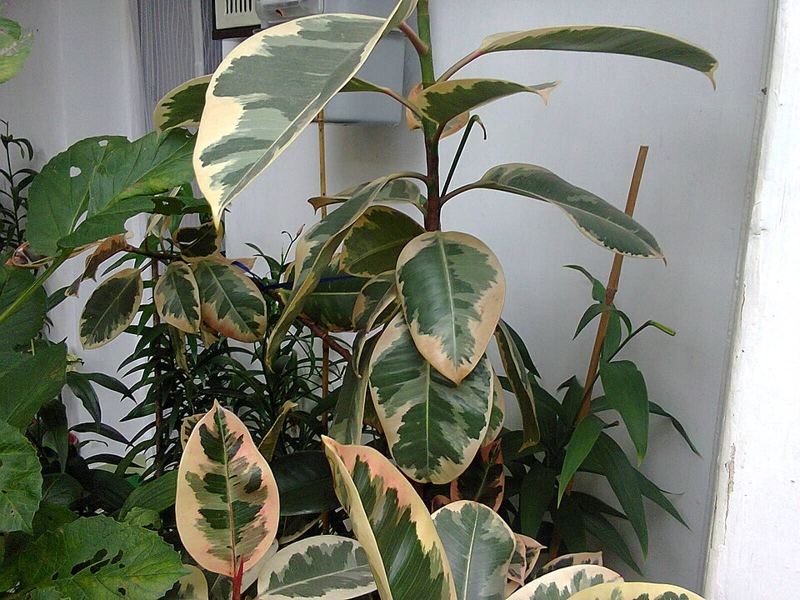
For a rubber plant in a pot, NC State’s only soil instruction is a soil-based potting mix, and none of our sources gives a repotting schedule, a pot size or a mix recipe. This guide covers what the sources do say about containers, soil, size and support, flags where the gaps are, and borrows carefully from the related fiddle-leaf fig where that helps. It supports our main rubber plant care guide.
The mix
NC State says: “When grown indoors, plant in a soil-based potting mix.” The same page says the plant does best “in dry soil,” a phrase we read alongside its watering advice to water regularly but avoid overwatering and to reduce watering in the dormant months from fall to late winter. We take this to mean the mix should not stay wet, but the page does not state a drainage requirement, perlite ratio or pH.
Texas A&M’s reference guide gives no soil advice for the rubber plant. Penn State’s page on ficus diseases is about disease and temperature, not potting. So the mix is a one-source answer: a soil-based potting mix.
Pot size and drainage
Our sources do not name a pot size or say that the pot needs drainage holes for Ficus elastica. Drainage is not discussed. That does not mean it does not matter. NC State’s warning that overwatering can cause leaf loss is the sourced reason to make sure water has somewhere to go, and it is the reason we would use a pot with holes and empty the saucer. That is our judgment from the overwatering warning, not a statement from NC State.
When to repot
No rubber plant source says when to repot. Texas A&M and NC State are silent on timing, signs of a root-bound plant and season. We checked the other plants in our set for a comparison and found two statements about a close relative:
- Penn State’s Adams County master gardener column, about the fiddle-leaf fig (also Ficus), says the plant “love[s] to be potbound but, like all plants, drainage is extremely important.”
- UF/IFAS EDIS says for the fiddle-leaf fig: “Be sure to cut roots circling the container before planting since these can cause the tree to become unstable as it grows older.”
Both are about Ficus lyrata. They are not about Ficus elastica, and we do not state that they apply. The Penn State piece is also a columnist’s personal routine, not research. If you are weighing whether to move a rubber plant up a pot size, they are a hint at what a ficus can tolerate, not a rule.
Size and support
NC State is the useful source for planning a container. It says that indoors the plant “rarely flowers and it is usually kept to 2 to 10 feet with training or support as needed.” In the wild it can reach 100 feet. For a pot, that gives a rough sense of the load: a 10-foot plant on a narrow stem is top-heavy.
The page also says to prune the main branches to encourage a bushier habit, or leave them unpruned for “a tall, narrow, more tree-like form.” A tall unpruned plant is more likely to need support. A pruned bushy one may not. The sources do not specify a stake type or height.
Temperature and where the pot sits
NC State says the plant “prefers to remain in one location and do not do well with drafts or cold temperatures,” with a preferred temperature greater than 55°F. Penn State says to maintain temperatures above 40°F. A pot on a bare floor beside an exterior door is in a position these sources warn against. Our light guide covers placement in more detail.
Questions to ask yourself before repotting
- Is the plant actually struggling? Our sources list leaf loss from overwatering, drafts and temperature drops. Check those first.
- Is the mix soil-based? NC State recommends a soil-based potting mix.
- Is the plant top-heavy? NC State says training or support may be needed as it grows.
- Do you have a drainage plan? The sources do not say, but overwatering is the one error NC State names.
Containers for a related plant
Our fiddle-leaf fig containers guide has more sourced detail about potbound roots, drainage and soil for another large-leaved ficus. For a plant that does need regular repotting and a climbing support, see the monstera containers guide. Neither replaces a rubber plant source, but both show what the sources can say.
What our sources do not tell you
We have no sourced repotting interval, pot size, pH, mix recipe, drainage advice or support type for Ficus elastica. Missouri Botanical Garden’s page was not available to us. Back to the rubber plant care guide for the full picture, or the propagation guide if you want to start a new plant instead.
Frequently asked questions
What soil does a rubber plant need?
NC State says to plant it indoors in a soil-based potting mix. It gives no recipe, pH or drainage additive.
How often should I repot a rubber plant?
Our sources do not say. NC State and Texas A&M give no repotting schedule for Ficus elastica.
Does a rubber plant like to be potbound?
Not stated for the rubber plant. For the related fiddle-leaf fig, Penn State's columnist says it loves to be potbound and UF/IFAS says to cut roots circling the container. Neither statement is about Ficus elastica.
Does a rubber plant need support?
NC State says it is usually kept to 2 to 10 feet with training or support as needed, and that unpruned main branches grow into a tall, narrow shape.
Sources
- Ficus elastica (Rubber Plant), NC State Extension Plant Toolbox
- Rubber Plant: A Reference Guide to Plant Care, Handling and Merchandising, Texas A&M AgriLife Extension (Aggie Horticulture)
- Ficus lyrata (Fiddle-leaf Fig), University of Florida IFAS Extension (EDIS ST254)
- Fiddle Leaf Fig (Ficus lyrata), Penn State Extension, Master Gardeners of Adams County