

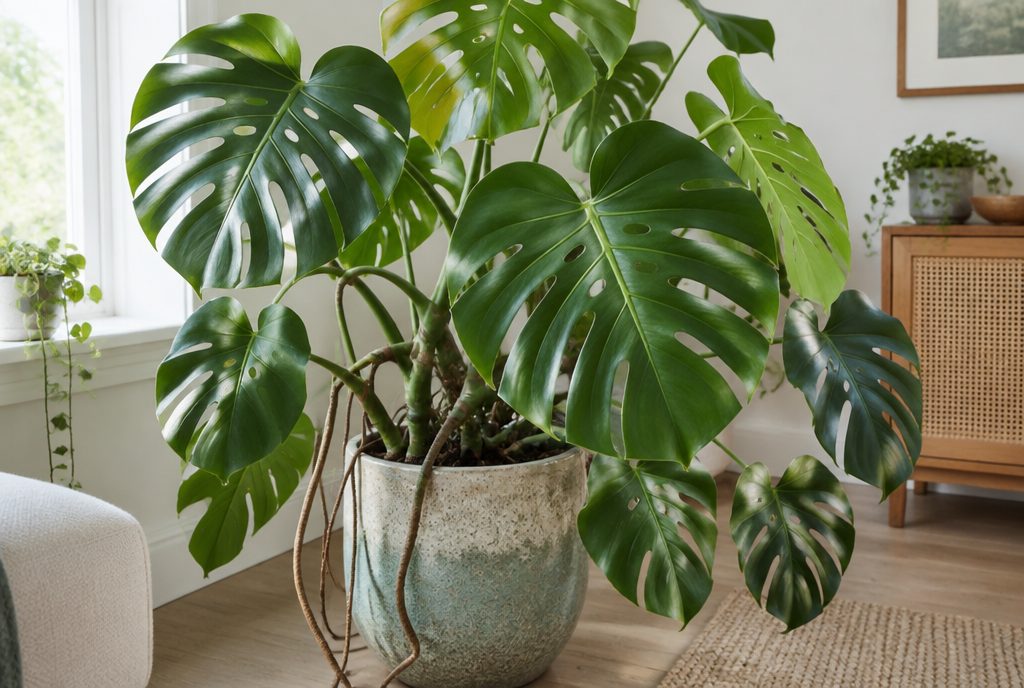
A monstera needs a sturdy support to climb and a roomy pot of soilless mix: Wisconsin Extension says to sink a tree bark or strong, moss-covered support into the pot, and NC State says to repot in spring if needed. Penn State lists moss sticks, trellises, bamboo stakes and sphagnum-covered boards as options. None of our sources gives a repotting interval, a pot size or a pole height, and we say so below. This page supports our main monstera care guide.
Why a monstera needs support
NC State says the monstera “stays between 6 to 8 feet in most home environments,” and “sturdy support is necessary to prevent the stems from breaking.” Penn State agrees on the size and says it “will need something sturdy to climb.” Wisconsin gives the reason: the plant produces aerial roots, and they need something to attach to.
What the sources say about supports
Wisconsin Extension
Penn State Extension
NC State Extension
The sources agree that support is needed, and they differ only on the exact form. Wisconsin is the most specific, with a construction method for a moss pole. Penn State gives a longer list of options. NC State states the need without naming a type.
Watering the support
Wisconsin makes a point other sources miss. It says to water thoroughly and allow the growing medium to dry slightly between waterings, “being sure to also water the moss-covered support so the aerial roots can obtain water and nutrients.” A moss pole is therefore part of the watering routine, not just a prop. For the soil, NC State says to let the top quarter to one-third dry, and Penn State says the top 1 to 2 inches.
Soil and mix
Penn State says: “When planting and repotting, use a well-draining soilless potting mix that is rich with organic matter and has a neutral pH (6.0 to 8.0).” Wisconsin says to grow the plant in “a fertile soilless mix, with ample root room to promote larger leaf growth.” The two agree on soilless. Neither names a brand or recipe.
Repotting
The sources give two statements, and neither is a schedule.
- NC State: “Prune or re-pot if needed in the spring and wipe dust off of the leaves regularly.”
- Wisconsin: “Container-grown plants need frequent repotting,” with ample root room promoting larger leaf growth.
Putting them together: spring is the season NC State names, and frequent repotting is Wisconsin’s description of a container-grown plant. “Frequent” is not defined. If the plant is thriving and the pot is not cramped, our sources give no reason to repot.
We cannot say how many inches to go up. Nothing in the sources gives a pot size or diameter.
What the sources do not say
- how tall a moss pole should be, or how to extend it as the plant grows
- how to attach the stems to the pole beyond the aerial roots attaching on their own
- whether to repot when adding a pole
- the signs that a plant is root-bound
- a pot size or material
Our research file for this plant flags the pole-height question specifically: we found no sourced guidance on extending a moss pole. We would rather say so than give a number.
A short checklist
- Choose the support. Wisconsin and Penn State both accept a moss-covered form. Bark and slat poles are named by Wisconsin, and trellises and bamboo stakes by Penn State.
- Sink it into the pot. Wisconsin says the support should be sunk into the pot, which is easiest when you are repotting.
- Water the moss as well. Wisconsin says this lets the aerial roots obtain water and nutrients.
- Repot in spring if needed. NC State names spring.
- Use a well-draining soilless mix. Penn State and Wisconsin both name soilless.
Light and humidity for a climbing plant
The pole does not change the plant’s needs. Penn State says bright light but not direct sun and humidity preferably above 50%, and Wisconsin says the leaf edges turn brown if humidity is too low. For the full picture see the care guide, and for new plants from a long stem see propagation.
Pets
The ASPCA lists the monstera as toxic to dogs and cats. When you are repotting, trimmings can be reached by pets, so clear them away. See our pet-safety guide.
What our sources do not tell you
We have no sourced pot size, repotting interval, pole height or method for extending a pole. We also have no root-bound signs. If you need any of those, check your state extension office. Our fiddle leaf fig containers guide shows a different plant where the sources say a plant can tolerate being potbound.
Frequently asked questions
What support does a monstera need?
Wisconsin Extension says a tree bark or strong, moss-covered support sunk into the pot for the aerial roots to attach to. Penn State says moss sticks, trellises, bamboo stakes and boards covered with sphagnum moss all work. NC State says sturdy support prevents stems breaking.
When should I repot a monstera?
NC State says to prune or repot if needed in the spring. Wisconsin says container-grown plants need frequent repotting and ample root room to promote larger leaves. Neither gives an interval.
What soil is best for a monstera?
Penn State says a well-draining soilless potting mix rich in organic matter with a neutral pH of 6.0 to 8.0 when planting and repotting. Wisconsin says a fertile soilless mix.
How do I attach a monstera to a moss pole?
Wisconsin Extension says to wrap sphagnum moss around a wooden slat and secure it with monofilament fishing line or nylon thread. It says to water the moss-covered support as well.
Sources
- Swiss-Cheese Plant, Monstera deliciosa, University of Wisconsin Horticulture Extension
- Monstera as a Houseplant, Penn State Extension
- Swiss Cheese Plant (Monstera deliciosa), NC State Extension Plant Toolbox