
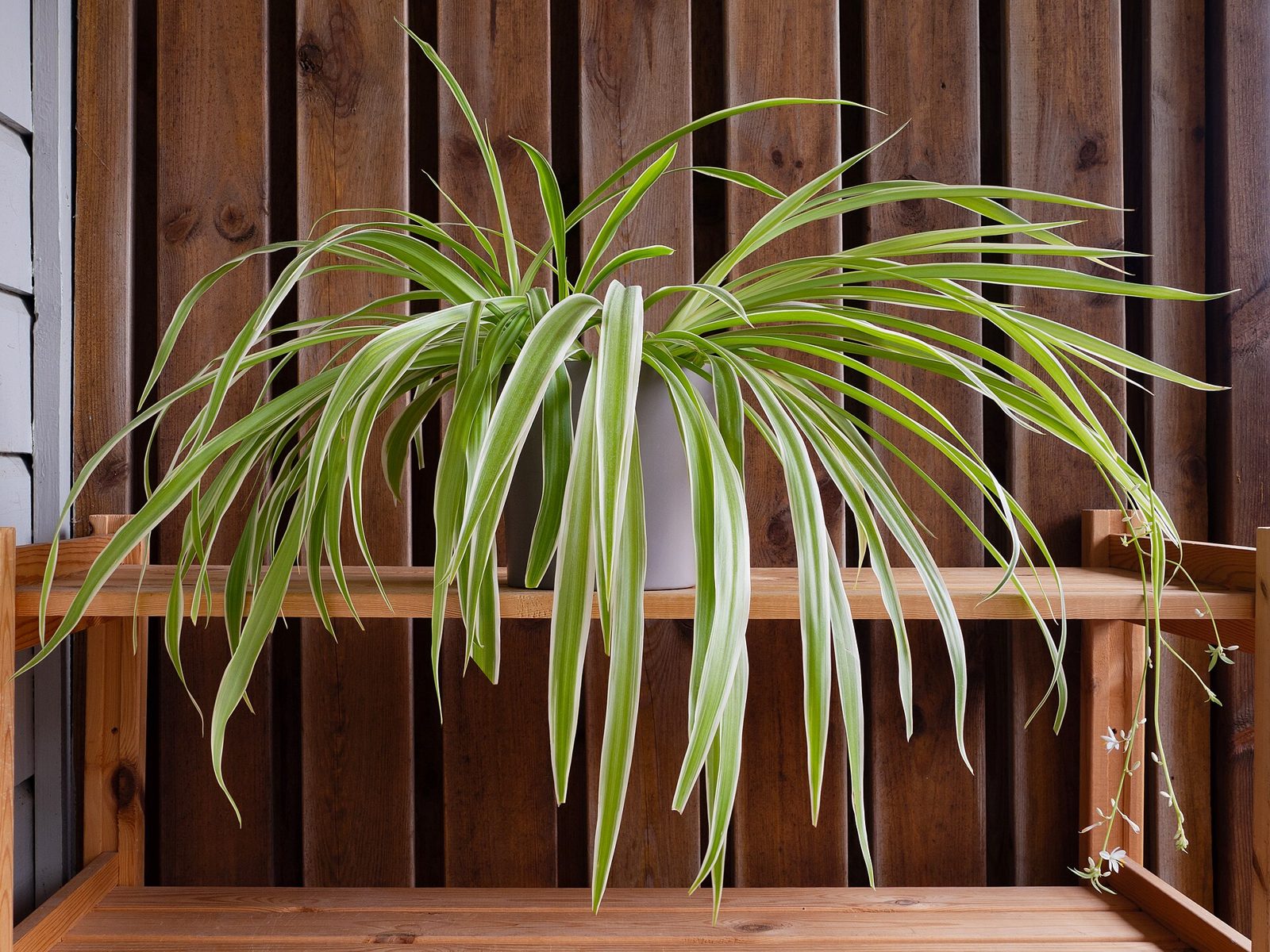
Our sources use the word “medium” for three of the 10 houseplants we cover: spider plant (NC State, Wisconsin), and rubber plant and fiddle leaf fig (both Texas A&M). Monstera gets “moderate brightness” from NC State, which is the closest wording. Every one of these four also has a source that names a brighter or dimmer range, so medium light is a middle ground and not a fixed rule.
What medium light means in a home
None of our sources gives a light level in foot-candles or lux, or a distance from a window. They use words. Wisconsin’s spider plant page says “medium to bright light throughout the year.” Texas A&M says “Medium light or some daily sun” for both ficus plants.
Our reading, which no source states: medium light is a spot a few feet back from a window, or a window that gives gentle light, brighter than the dim corners in our low light plants guide and without the direct beam that direct sun plants covers. If your room fits that description, the plants below are the ones our sources point to.
Plants our sources place in medium light
| Plant | What the source says | Source |
|---|---|---|
| Spider plant | “Prefers medium light levels yet can tolerate deep shade”; “medium to bright light throughout the year” | NC State, Wisconsin |
| Rubber plant | “Light: Medium light or some daily sun” | Texas A&M |
| Fiddle leaf fig | “Light: Medium light or some daily sun” | Texas A&M |
| Monstera | “Moderate brightness but not direct sunlight”; “bright light but not direct sun” (Penn State) | NC State, Penn State |
Three plants use the word “medium,” so that is the count we give. Monstera is our closest match by wording, and we treat “moderate” as roughly the same step, which is our reading.
Rubber plant and fiddle leaf fig: three sources, three answers
These two plants have the widest spread of any in our list:
- Rubber plant. NC State says “bright indirect light or partial shade and protection from the afternoon sun” for indoor plants, and elsewhere says it “does best in partial shade or low light.” Texas A&M says “Medium light or some daily sun.”
- Fiddle leaf fig. NC State says it “prefers bright indirect light or partial shade” and “need protection from the afternoon sun.” UF/IFAS EDIS says “full sun to partial shade.” Texas A&M says “Medium light or some daily sun.”
That is a range from partial shade to full sun, with Texas A&M in the middle. Our reading is that “some daily sun” is brighter than NC State’s partial shade. NC State also warns that “Leaf scorch can occur if the plant is receiving too much direct sunlight” on fiddle leaf fig. Our reading is that the middle of the range is the safer starting point.
Spider plant: medium, with room either side
NC State says spider plant “can tolerate deep shade” but is “intolerant of direct sunlight.” Clemson says it grows best with bright indirect light, and adds: “They can tolerate some direct sunlight, but midday light may scorch leaves.” That is a real conflict on direct sun, and the overlap is medium to bright light without midday sun.
Monstera: the signs of too little
Penn State says to place it where it can get “bright light but not direct sun.” Wisconsin says it can be grown under fluorescent light “but will not develop the leaf perforations when light is inadequate.” NC State says variegated types need more light. If you grow monstera for its split leaves, give it more than a dim room.
Plants that fit a different level
- Snake plant, ZZ plant, pothos and peace lily. Sources say these tolerate lower light and prefer brighter indirect light. See low light plants and bright indirect light plants.
- Calathea. NC State says bright indirect light or partial shade, and that direct sun damages the leaves. See bright indirect light plants.
- Aloe vera. Sources say full sun to bright indirect light. See direct sun plants.
How to use this
- Treat “medium” as a starting point. All four plants have another source pointing brighter or dimmer.
- Watch the plant, not the label. Sources name signs of too little light, such as monstera without leaf perforations. They name signs of too much, such as scorch on fiddle leaf fig and midday scorch on spider plant.
- Match care to the light. Our reading is that soil dries more slowly here than on a sunny sill, which the sources do not compare. Our how often to water houseplants guide sets out the watering rule for each, and how to fertilize houseplants covers feeding.
Short version
Spider plant, rubber plant and fiddle leaf fig are the plants our sources describe as medium light, and monstera is close behind at “moderate brightness.” Treat medium as a spot back from a window, and expect the sources to disagree on how far each plant can go brighter or dimmer.
Frequently asked questions
What is medium light for houseplants?
Our sources do not define it with a number or a distance from a window. Wisconsin says spider plant wants "medium to bright light throughout the year," and Texas A&M says "Medium light or some daily sun" for rubber plant and fiddle leaf fig. Our reading is a spot a few feet back from a window.
Which houseplants do sources say need medium light?
Spider plant (NC State, Wisconsin), rubber plant and fiddle leaf fig (Texas A&M) use the word medium. NC State says monstera wants "moderate brightness but not direct sunlight," which is the nearest wording.
Can medium light plants live in low light?
Only spider plant has wording for it. NC State says it "prefers medium light levels yet can tolerate deep shade." Our sources do not say the same for rubber plant or fiddle leaf fig.
Do medium light plants need direct sun?
Not by NC State's account of spider plant, which is "intolerant of direct sunlight." Texas A&M says "some daily sun" for rubber plant and fiddle leaf fig, while NC State says to protect both from the afternoon sun.
Sources
- Chlorophytum comosum (spider plant), Plant Toolbox, NC State Extension
- Spider plant, Chlorophytum comosum, University of Wisconsin-Madison Extension
- Spider plant, Clemson Home & Garden Information Center
- Ficus elastica (rubber plant), Plant Toolbox, NC State Extension
- Ficus lyrata (fiddle-leaf fig), Plant Toolbox, NC State Extension
- Ficus lyrata, fiddle leaf fig, UF/IFAS EDIS
- Rubber plant, Texas A&M AgriLife, Aggie Horticulture
- Fiddle leaf fig, Texas A&M AgriLife, Aggie Horticulture
- Monstera deliciosa (Swiss cheese plant), Plant Toolbox, NC State Extension
- Monstera deliciosa, University of Wisconsin-Madison Extension
- Monstera as a houseplant, Penn State Extension