

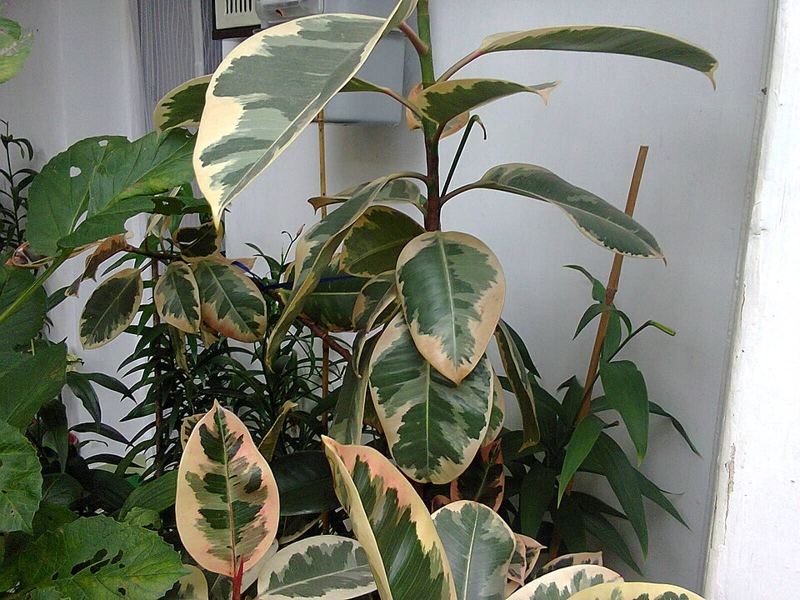
Of the 10 houseplants we cover, seven have a feeding schedule from an extension source, and they run from every two weeks to once or twice a year. Monstera sits at the frequent end and ZZ plant at the rare end. Fiddle leaf fig has only a columnist’s personal routine, and aloe vera and rubber plant have no feeding guidance in our sources at all.
Feeding schedule for each plant
| Plant | How often | Type and strength | Season | Source |
|---|---|---|---|---|
| Snake plant | Monthly, “for a more robust plant” | All-purpose, half strength | Growing season | Penn State |
| Peace lily | Every six to eight weeks (Clemson); three times a year (UF/IFAS EDIS) | Balanced liquid such as 20-20-20 at one-quarter strength (Clemson); “low dose” liquid (EDIS) | Spring and summer (Clemson) | Clemson, UF/IFAS EDIS |
| Spider plant | Every 3 to 4 months, or more often at half strength | Water-soluble or time-release (Clemson) | Active growth | Wisconsin, Clemson |
| Aloe vera | Not stated | Not stated | Not stated | None of our sources |
| Pothos | Every other month (NC State, Wisconsin); Penn State differs, see below | Houseplant fertilizer | Not winter (NC State, Wisconsin) | NC State, Wisconsin, Clemson, Penn State |
| Rubber plant | Not stated | Not stated | Not stated | None of our sources |
| Fiddle leaf fig | One columnist’s routine, not a research rate | Liquid 3-1-2, one tablespoon per gallon | At watering | Penn State (columnist) |
| ZZ plant | Once or twice a year to once or twice a month, depending on source | Balanced liquid | Growing season | NC State, Clemson, Illinois, UF/IFAS EDIS |
| Calathea | Monthly | Balanced houseplant fertilizer | Growing season, spring through summer | NC State |
| Monstera | Every two weeks, monthly in winter (Penn State) | Balanced houseplant fertilizer | Spring to fall, plus winter (Penn State) | Penn State, Wisconsin |
Sources give strength as a fraction of the label dose, such as half strength or one-quarter strength. The only ratios named are 20-20-20 (Clemson, peace lily) and 3-1-2 (a Penn State columnist, fiddle leaf fig). No source names a brand or product, and neither do we.
Where sources disagree
Peace lily. Clemson says: “use a balanced, liquid houseplant fertilizer, such as 20-20-20, every six to eight weeks during the spring and summer growing season,” mixed at “one-quarter of the recommended strength.” UF/IFAS EDIS says: “Apply a low dose of liquid fertilizer according to manufacturer instructions three times per year.” Clemson feeds more often, and EDIS gives no strength.
ZZ plant. This is the widest split. NC State says: “Use a balanced liquid houseplant fertilizer once or twice a year.” UF/IFAS EDIS also says twice a year. Clemson says “once or twice during the growing season.” Illinois Extension says: “Provide a light supply of balanced fertilizer once or twice a month at the time of watering during the spring and summer months.” The first three agree on once or twice per year or season, and Illinois alone says per month. Clemson’s reason is that ZZ plants are “slow-growing.”
Pothos. NC State says: “Fertilize every other month except when the plant is dormant in the winter.” Wisconsin says the same, “except during the winter when the plant is not actively growing.” Clemson says every other month in spring and summer. Penn State says: “fertilize pothos with a balanced houseplant food monthly through the winter and every two weeks throughout the rest of the year.” That is the only source that feeds in winter, and it feeds more often than the others at every other time.
Monstera. Penn State: “Fertilize every two weeks through the growing season and monthly through the winter.” Wisconsin: “Fertilize regularly from spring until fall,” with no interval and no winter feeding. They agree on the growing season but not on winter.
Fiddle leaf fig. The Penn State source is an Extension county news column, not a research rate. The writer says: “When I am ready to water, I infuse the gallon of water with a tablespoon of a liquid fertilizer that has a ratio of 3-1-2.” Treat it as one grower’s routine. Our sources give no extension rate for this plant.
Seasons: when sources say to hold back
- Pothos: skip winter, when it is dormant (NC State, Wisconsin), apart from Penn State’s winter schedule above.
- Calathea: NC State’s majestic prayer plant page says to “Reduce watering and fertilization in the winter when plant growth typically slows down.”
- Snake plant, peace lily, spider plant, calathea: sources tie feeding to the growing season or active growth. Our reading is that this means no feeding outside it.
- Rubber plant: NC State says to reduce watering when dormant, from fall to late winter, and says nothing about feeding.
Our sources do not say whether to feed a plant that is newly repotted, stressed or recovering. For pot and mix, see repotting houseplants.
What too much fertilizer does
- Peace lily: “Overfertilizing peace lilies can cause the leaf tips and roots to burn and turn brown” (Clemson).
- Spider plant: “Do not over-fertilize, as this decreases plantlet formation” (NC State). Wisconsin adds that heavily fertilized plants “may not form as many plantlets and excessive fertilizer may lead to tip browning.” Clemson says leaf tip burn is caused by “too much fertilizer or water that is high in soluble salts.”
- Pothos: blackened leaf margins or tips “can be caused by overwatering, inadequate watering, or excess fertilizer” (Wisconsin).
Brown tips therefore do not prove a feeding problem. Humidity for houseplants and how often to water houseplants cover the other causes.
Short version
Most sources tie feeding to the growing season. They span monthly for snake plant and calathea, every two weeks for monstera, and once or twice a year for ZZ plant. Pothos skips winter in two sources, Clemson names spring and summer, and Penn State feeds through winter. Aloe vera and rubber plant have no stated schedule, and fiddle leaf fig has only one columnist’s routine. For easy plants to start with, see easy houseplants.
Frequently asked questions
How often should I fertilize houseplants?
It varies by plant in our sources. Penn State says monstera every two weeks in the growing season, snake plant and calathea are monthly (Penn State, NC State), pothos every other month (NC State, Wisconsin), and ZZ plant once or twice a year (NC State, UF/IFAS EDIS). Aloe vera and rubber plant have no stated schedule.
Should I fertilize houseplants in winter?
Sources disagree. NC State and Wisconsin say to skip winter for pothos, and NC State says to reduce fertilization in winter for the majestic prayer plant. Penn State says to feed monstera monthly through winter and pothos monthly through winter.
Can you fertilize a houseplant too much?
Sources say yes. Clemson says overfertilizing peace lilies can burn and brown the leaf tips and roots, NC State says over-fertilizing decreases plantlet formation in spider plant, and Wisconsin says excess fertilizer can blacken pothos leaf margins or tips.
What fertilizer should I use on fiddle leaf fig?
Our sources give no extension rate. The only guidance is a Penn State columnist's personal routine of a liquid fertilizer with a 3-1-2 ratio, one tablespoon per gallon of water, at watering.
Sources
- Dracaena trifasciata (Mother-in-law's tongue), Plant Toolbox, NC State Extension
- Snake plant, a forgiving low-maintenance houseplant, Penn State Extension
- Peace lily, Clemson Home & Garden Information Center
- Spathiphyllum, EDIS, UF/IFAS EDIS
- Spider plant, Chlorophytum comosum, University of Wisconsin-Madison Extension
- Chlorophytum comosum (spider plant), Plant Toolbox, NC State Extension
- Spider plant, Clemson Home & Garden Information Center
- Epipremnum aureum (pothos), Plant Toolbox, NC State Extension
- How to grow pothos indoors, Clemson Home & Garden Information Center
- Pothos, Epipremnum aureum, University of Wisconsin-Madison Extension
- Pothos as a houseplant, Penn State Extension
- Fiddle leaf fig (Ficus lyrata), Penn State Extension
- Zamioculcas zamiifolia (ZZ plant), Plant Toolbox, NC State Extension
- ZZ plant, indoor care and growing tips, Clemson Home & Garden Information Center
- ZZ plant, houseplant spotlight, University of Illinois Extension
- ZZ plant, EDIS, UF/IFAS EDIS
- Goeppertia kegeljanii (network plant), Plant Toolbox, NC State Extension
- Goeppertia roseopicta (rose-painted calathea), Plant Toolbox, NC State Extension
- Goeppertia majestica (majestic prayer plant), Plant Toolbox, NC State Extension
- Monstera as a houseplant, Penn State Extension
- Monstera deliciosa, University of Wisconsin-Madison Extension