

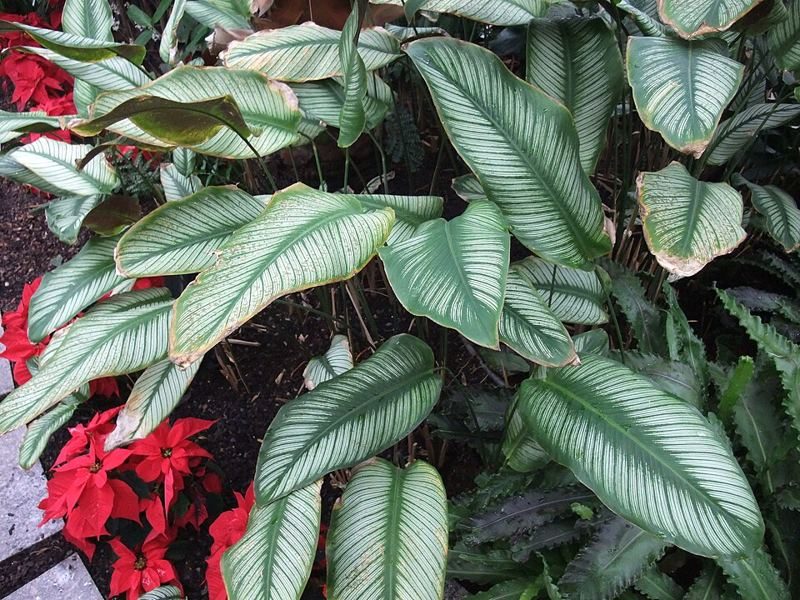
Of the 10 houseplants we cover, our sources put a number on humidity for only three: pothos (50 to 70% preferred), calathea (60% or more, depending on the species) and monstera (preferably above 50%). Snake plant and ZZ plant are described as fine in ordinary home air. Three more get a word with no number, and peace lily and aloe vera get nothing at all.
What the sources say, plant by plant
| Plant | Humidity wording | Source |
|---|---|---|
| Snake plant | “It tolerates low humidity”; “adapted to the low humidity … of homes and businesses.” No range given | NC State, UGA |
| ZZ plant | “will thrive with regular indoor humidity levels”; “adapts to variable humidity levels” | Clemson, Illinois |
| Peace lily | Not stated | None of our sources |
| Aloe vera | Not stated | None of our sources |
| Spider plant | “Medium air humidity” (NC State); “average humidity” (Wisconsin). No percentage | NC State, Wisconsin |
| Rubber plant | “Medium relative humidity”. No percentage | NC State |
| Fiddle leaf fig | “Medium relative humidity”. No percentage | NC State |
| Pothos | “Preferred range: 50 to 70%”; “Average home range: 30 to 60%”; Wisconsin says “high humidity” | Clemson, Wisconsin |
| Monstera | “likes humidity, preferably above 50%” (Penn State); “high humidity” (NC State) | Penn State, NC State |
For peace lily, the one source in our research that gave humidity guidance could not be read, so we have no sourced wording. We would rather leave it blank than guess.
Calathea depends on the species
NC State publishes a separate page for each Goeppertia (formerly Calathea) species, and the humidity differs:
| Species | Humidity wording |
|---|---|
| Network prayer plant | “A humidity level of at least 60%” |
| Rose-painted calathea | “The humidity level should be above 60%” |
| Majestic prayer plant | “It requires 60% humidity” |
| Alberta prayer plant | “High humidity of up to 60 to 70%” |
These are four species, not one rule for every calathea. The range across them is 60% to 70%.
Where sources leave gaps
- “Medium” and “average” are never defined. NC State and Wisconsin use these words for spider plant, rubber plant and fiddle leaf fig without a percentage.
- Pothos has the only “home” figure. Clemson gives 30 to 60% as the average home range and 50 to 70% as preferred, and adds “Pothos will tolerate these low humidity levels.” Our reading, which no source states: a calathea at 60% or more sits at the top of Clemson’s home range or above it.
- Pothos wording differs. Clemson says it tolerates the low end of a home. Wisconsin simply says “high humidity.”
- No source gives a way to measure. The humidity wording we collected does not say how to check your own room.
Which plants ask the most of your air
Our reading, since the sources do not rank plants: calathea makes the most specific demand on the list, with 60% or more in every species profile we read. Pothos and monstera both name 50% as the floor of their preferred range, though Clemson also says pothos tolerates a normal home. Snake plant and ZZ plant are described only by tolerance, and spider plant gets “medium” or “average” with no figure. If a room is dry and you want a plant with the least fuss, the tolerance wording points to snake plant and ZZ plant.
Signs of low humidity, as sourced
Brown leaf edges and tips are the symptom sources name most, and humidity is rarely the only cause listed.
- Calathea: “Brown leaves and tips can result from low humidity or fluoride in the tap water” (NC State, rose-painted calathea). The network prayer plant page adds that underwatering and tap water can cause brown edges and tips.
- Monstera: “The leaf edges will turn brown if humidity is too low” (Wisconsin).
- Spider plant: “Low humidity, excessively dry soil, salt accumulation and/or chemicals, particularly fluoride or chlorine, in tap water may cause brown leaf tips” (Wisconsin). Clemson says low humidity and excessively dry soil.
- Pothos: “Leaf Scorch and tip dieback: Often caused by low humidity or intense light” (Clemson).
- Peace lily: Clemson says leaf edges “can turn brown by overfertilization or by excessive drying,” and does not name humidity.
Because the same symptom has several listed causes, check the soil and the water first. Our guides to how often to water houseplants and how to fertilize houseplants cover two of them.
Ways to raise humidity, only as the sources describe
Our sources describe very little, so this list is short.
- A humidifier. Clemson: “Pothos will tolerate these low humidity levels, but humidity can also be supplemented with a humidifier.”
- Wet pebbles or a humidified room. NC State, for the majestic prayer plant: “consider placing the plant container on a bed of wet pebbles or growing the plant in a humidified room.”
- Distance from vents. Clemson says to keep pothos “away from air conditioning vents in the summer and from windowsills and heating vents in the winter, as hot and cold air can cause the leaves to dry out and damage plant cells.” NC State says fiddle leaf fig can get brown spots when room temperature fluctuates with heating or cooling vents.
- Distilled or rain water for calathea. NC State says “the fluoride in tap water can cause the leaves to develop brown edges.” This addresses brown tips but does not change humidity.
The sources we collected say nothing about misting, grouping plants or covering them, so we do not cover those here.
Short version
Humidity is the factor where our sources say least. Pothos, calathea and monstera have figures, snake plant and ZZ plant are described as tolerant, and peace lily and aloe vera are not stated. Of the ten, calathea has the highest figure at 60% or more. For tolerant, forgiving plants see easy houseplants, and for the plants our sources say cope with dim rooms see low light plants.
Frequently asked questions
What humidity do houseplants need?
It depends on the plant, and our sources give figures for only three. Clemson says pothos prefers 50 to 70%, NC State says the calathea species it profiles need 60% or more (up to 60 to 70% for one), and Penn State says monstera likes humidity, preferably above 50%. Snake plant and ZZ plant are described as fine in ordinary home air, and peace lily and aloe vera are not stated.
Do houseplants need misting?
Our sources do not say. The only ways to raise humidity they describe are a humidifier (Clemson, for pothos) and a bed of wet pebbles or a humidified room (NC State, for the majestic prayer plant).
Why are my houseplant's leaf tips brown?
Sources list several causes. Low humidity is named for calathea, monstera, spider plant and pothos, but so are dry soil, fluoride or chlorine in tap water, salt build-up and too much fertilizer. Check the soil and the water first, then humidity.
Which houseplants cope with dry air?
NC State says snake plant tolerates low humidity, and UGA says it is adapted to the low humidity of homes. Clemson says ZZ plants will thrive with regular indoor humidity levels, and Clemson says pothos will tolerate low humidity levels. Peace lily and aloe vera are not stated in our sources.
Sources
- Dracaena trifasciata (Mother-in-law's tongue), Plant Toolbox, NC State Extension
- Snake plant, a striking and durable houseplant, University of Georgia Extension
- ZZ plant, indoor care and growing tips, Clemson Home & Garden Information Center
- ZZ plant, houseplant spotlight, University of Illinois Extension
- Chlorophytum comosum (spider plant), Plant Toolbox, NC State Extension
- Spider plant, Chlorophytum comosum, University of Wisconsin-Madison Extension
- Spider plant, Clemson Home & Garden Information Center
- Ficus elastica (rubber plant), Plant Toolbox, NC State Extension
- Ficus lyrata (fiddle-leaf fig), Plant Toolbox, NC State Extension
- Epipremnum aureum (pothos), Plant Toolbox, NC State Extension
- How to grow pothos indoors, Clemson Home & Garden Information Center
- Pothos, Epipremnum aureum, University of Wisconsin-Madison Extension
- Goeppertia kegeljanii (network plant), Plant Toolbox, NC State Extension
- Goeppertia roseopicta (rose-painted calathea), Plant Toolbox, NC State Extension
- Goeppertia majestica (majestic prayer plant), Plant Toolbox, NC State Extension
- Goeppertia albertii (Alberta prayer plant), Plant Toolbox, NC State Extension
- Monstera as a houseplant, Penn State Extension
- Monstera deliciosa (Swiss cheese plant), Plant Toolbox, NC State Extension
- Monstera deliciosa, University of Wisconsin-Madison Extension
- Peace lily, Clemson Home & Garden Information Center