

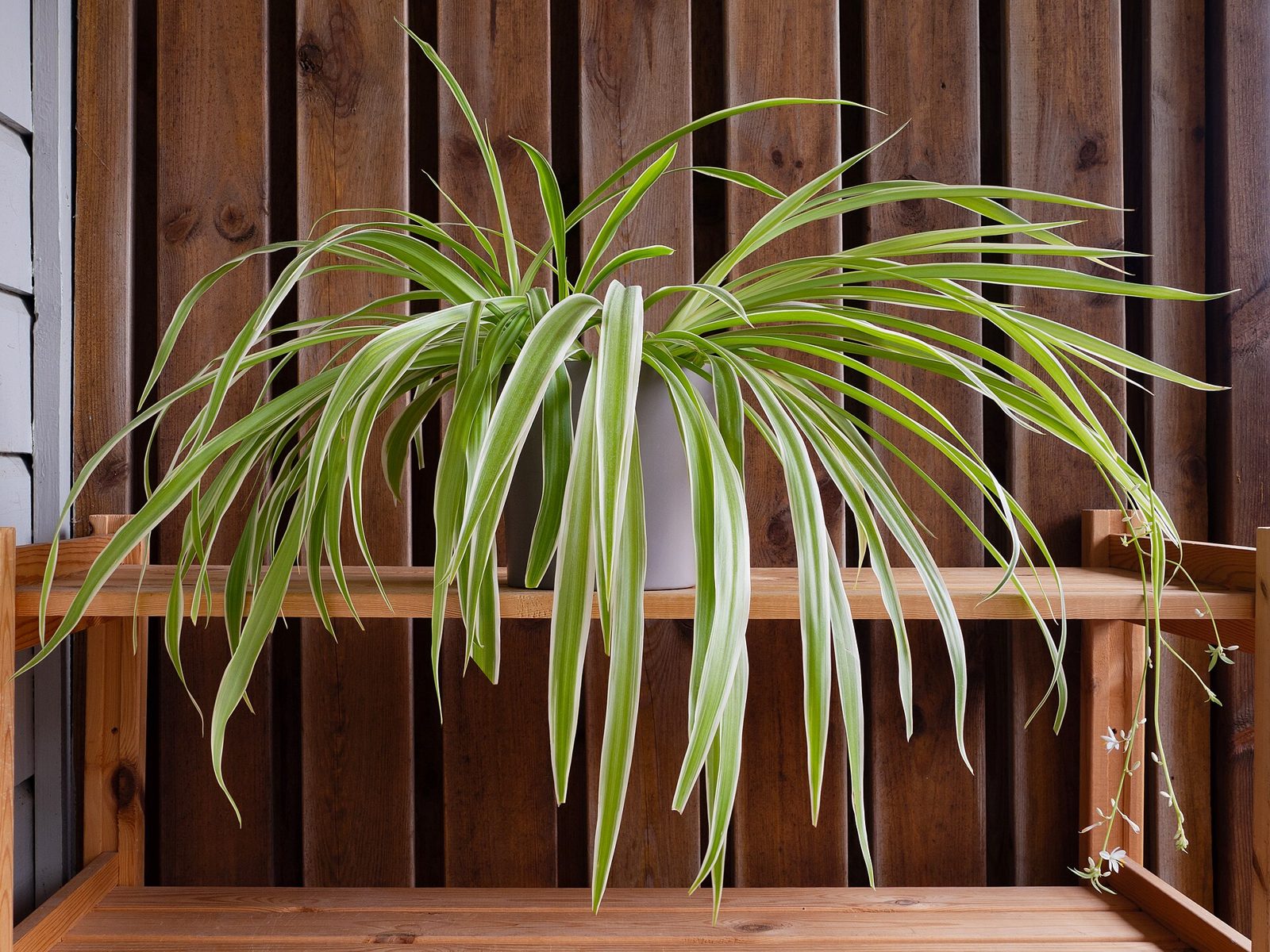
Spider plants are among the easiest houseplants to propagate: pot up the plantlets that dangle from the long stems, or divide a large plant. NC State says it propagates easily by plantlets or division. This guide sits under our main spider plant care guide and sticks to what the extension sources say about each method.
Method 1: root a plantlet while it is still attached
Wisconsin describes this approach most fully. Set the plantlet, still attached to the mother plant, on the surface of a pot filled with soilless potting medium and allow it to root before severing the stem that connects it to the mother plant. Wisconsin notes that the plant produces long, wiry stems up to 2 feet long, so the plantlet can usually reach a second pot placed beside the parent.
- Choose a plantlet on a stem. Pick one growing on the long stems of the mother plant (Wisconsin).
- Set it on a pot of soilless potting medium. Keep it attached and rest it on the surface of the pot (Wisconsin).
- Let it root. Wait for roots to form before you cut anything (Wisconsin). The sources give no time frame.
- Sever the stem. Cut the stem that joins it to the mother plant once it has rooted (Wisconsin).
Method 2: pot up a plantlet that already has roots
Wisconsin says another common method is to simply remove and pot up a plantlet that has already started developing roots. Clemson says to detach plantlets once roots have formed and pot them directly into moist growing mix. UF/IFAS puts it simply: to propagate your spider plant, remove and pot the plantlets.
This is the fast route. If a plantlet at the end of a stem already shows small roots, you can cut it free and plant it. Use moist growing mix (Clemson) or a soilless medium (Wisconsin). A general-purpose potting soil also suits the plant when it is established (Clemson, Wisconsin).
Method 3: divide a large plant
Wisconsin says larger plants can also be divided, and NC State lists division alongside plantlets. Clemson ties the timing to the roots: divide and repot plants before the roots expand enough to crack the container. UF/IFAS says to repot once a year while the plant is young and then every other year once it matures, so repotting time is a natural moment to divide a plant whose pot is full.
The sources do not say how to separate the roots, how many divisions to make or how to handle damaged ones. Be gentle and keep roots and leaves together on every piece.
Getting more plantlets
If your plant is not making plantlets, two sources point at feeding. Wisconsin says heavily fertilized plants may not form as many plantlets and excessive fertilizer may lead to tip browning, and NC State says not to over-fertilize because it decreases plantlet formation. NC State also says stolons and plantlets are light dependent and develop when the mother plant receives short days. It does not give hours of daylight.
Caring for new plants
Treat new plants like any spider plant. Our care guide has the full details, and the short version from the sources is:
- Light: bright indirect light (Clemson), or medium to bright (Wisconsin). Midday sun may scorch leaves (Clemson).
- Water: let the soil dry briefly between waterings (Clemson, UF/IFAS).
- Temperature: Clemson says 65 to 75°F by day and 50 to 55°F at night are ideal, and NC State says to keep temperatures above 45°F.
- Tap water: NC State says chlorine and fluorides in tap water can cause leaf tip burn, and Wisconsin lists them as a cause of brown tips. See our brown tips guide.
Pets and propagation
The ASPCA’s plant page lists the spider plant as non-toxic to dogs and cats, but its 2019 houseplant article calls it mildly toxic. Because the two disagree, keep plantlets and trimmings out of pets’ reach. Our pet safety page gives both statements.
What our sources do not tell you
The sources do not say how long plantlets take to root, whether to root them in water, how big a plantlet should be before you cut it, or what time of year is best. They do not tell you how many plantlets a mother plant can lose. For other trailing houseplants that root from cuttings, our pothos propagation guide covers stem cuttings. Back to the spider plant care guide for the rest.
Frequently asked questions
How do I propagate a spider plant from plantlets?
Wisconsin says to set a plantlet, still attached to the mother plant, on a pot of soilless potting medium and let it root before severing the stem. Clemson says to detach plantlets once roots have formed and pot them into moist growing mix.
Do I need to wait for the plantlet to grow roots?
Sources describe both routes. Wisconsin and Clemson say you can pot up a plantlet that has already started developing roots, and Wisconsin says you can also root it while still attached.
Can I divide a spider plant?
Yes. Wisconsin says larger plants can also be divided, and NC State says the plant propagates easily by plantlets or division. Clemson says to divide and repot before the roots crack the container.
Why is my spider plant not producing plantlets?
Wisconsin and NC State both say too much fertilizer reduces plantlet formation. NC State adds that stolons and plantlets are light dependent and develop when the mother plant receives short days.
Sources
- Spider Plant (Chlorophytum comosum), University of Wisconsin-Madison Division of Extension, Horticulture
- Spider Plant, Clemson Cooperative Extension, Home and Garden Information Center
- Spider Plant, University of Florida IFAS Gardening Solutions
- Chlorophytum comosum, NC State Extension Plant Toolbox