

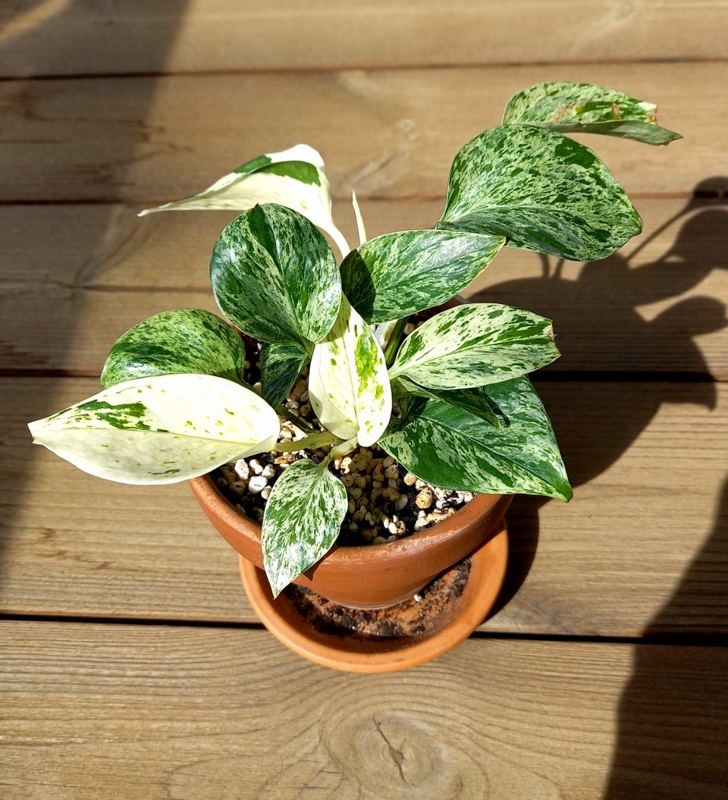
Pothos is easy to propagate from stem cuttings: Clemson says they root easily in soil or water as long as each cutting has at least one node. Wisconsin says rooting in water or vermiculite takes 3 to 4 weeks, and Penn State says spring through summer is the better time. This guide sits under our main pothos care guide and covers the methods the extension sources describe.
The key detail: the node
Clemson’s wording is the one to remember: stem cuttings can be easily rooted when placed in soil or water but should have at least one node to root properly. A node is the joint on the vine where a leaf is attached. Our sources do not define it further, and they do not say how long a cutting should be or how many leaves to leave on it, so use the node as your guide and keep at least one on every piece.
Method 1: stem cuttings in water or soil
- Take a stem cutting with at least one node. Clemson says it needs at least one node to root properly.
- Place it in water or in soil. Clemson says either works. Wisconsin names water or vermiculite as the rooting medium and says the vines root within 3 to 4 weeks.
- Wait for roots. Wisconsin’s range is 3 to 4 weeks. The sources do not say how long the roots should be before potting.
- Pot it up in a well-draining mix. Clemson says pothos should be potted in an airy, well-draining mix, and Penn State says a good-quality soilless mix that drains well.
When to take cuttings
Penn State says propagation through stem cuttings is more successful during the growing season from spring through summer. It does not say that cuttings taken in other seasons will fail, only that they are less successful. If you want the best chance, plan for spring or summer.
Other methods
Penn State describes two more approaches. It says that propagation through layering can also be successful, which fits a vine that roots where its stem touches a medium. It also says you can propagate through root division during the annual repotting, which is when a crowded plant is out of its pot. Neither source gives steps for layering or division, so we do not either. Penn State says to pot pothos up annually in spring, which makes spring a natural moment for division.
Water or soil?
Clemson says either works, so the choice is about convenience. Water lets you watch roots form, and Wisconsin’s 3 to 4 week figure refers to rooting in water or vermiculite. Soil skips the later transfer, and Clemson says cuttings root easily there too. Our sources do not compare the two for success rate or say whether a plant rooted in water adjusts differently to soil, so we do not rank them. Whichever you choose, keep the node in contact with the medium, because Clemson says the node is what roots.
Looking after new plants
New cuttings should get the same care as an established pothos.
- Light: bright, indirect light, and out of direct sun (Clemson, Penn State). Lower light may cause variegated types to lose some coloring (Clemson, NC State).
- Water: let the soil dry between waterings and then water thoroughly (Clemson). Penn State says pothos is better kept too dry than too wet.
- Humidity and temperature: Clemson prefers 50 to 70% humidity and 70 to 85°F by day. Our care guide covers where the sources differ.
- Feeding: NC State and Wisconsin say every other month except in winter. Our sources do not say when to start feeding a new cutting.
Cuttings and pets
The ASPCA lists pothos, under the name devil’s ivy, as toxic to dogs and toxic to cats, and Clemson says all parts are mildly toxic if ingested. A jar of cuttings on a windowsill is within reach of a curious pet, so keep it somewhere the animal cannot get to. Our pet safety page has the details.
What our sources do not tell you
Our sources do not say how long a cutting should be, how many leaves to keep, whether to change the water, how long roots should be before potting or how to get a full-looking pot. For a different kind of plantlet-based propagation, see our spider plant guide. For everything else on this plant, go back to the pothos care guide.
Frequently asked questions
Can you propagate pothos in water?
Yes. Clemson says stem cuttings can be easily rooted in soil or water but should have at least one node. Wisconsin says the vines root in water or vermiculite within 3 to 4 weeks.
What part of the stem do I cut?
Clemson says a cutting should have at least one node to root properly. The sources do not say where on the vine to cut or how long a cutting should be.
When is the best time to propagate pothos?
Penn State says propagation through stem cuttings is more successful during the growing season, from spring through summer.
How long do pothos cuttings take to root?
Wisconsin says the vines root in water or vermiculite within 3 to 4 weeks.
Are there other ways to propagate pothos?
Penn State says layering can also be successful, and that you can propagate through root division during the annual repotting.
Sources
- How to Grow Pothos Indoors: Epipremnum spp. Care, Cultivars and Common Problems, Clemson Cooperative Extension, Home and Garden Information Center
- Pothos (Epipremnum aureum), University of Wisconsin-Madison Division of Extension, Horticulture
- Pothos as a Houseplant, Penn State Extension