

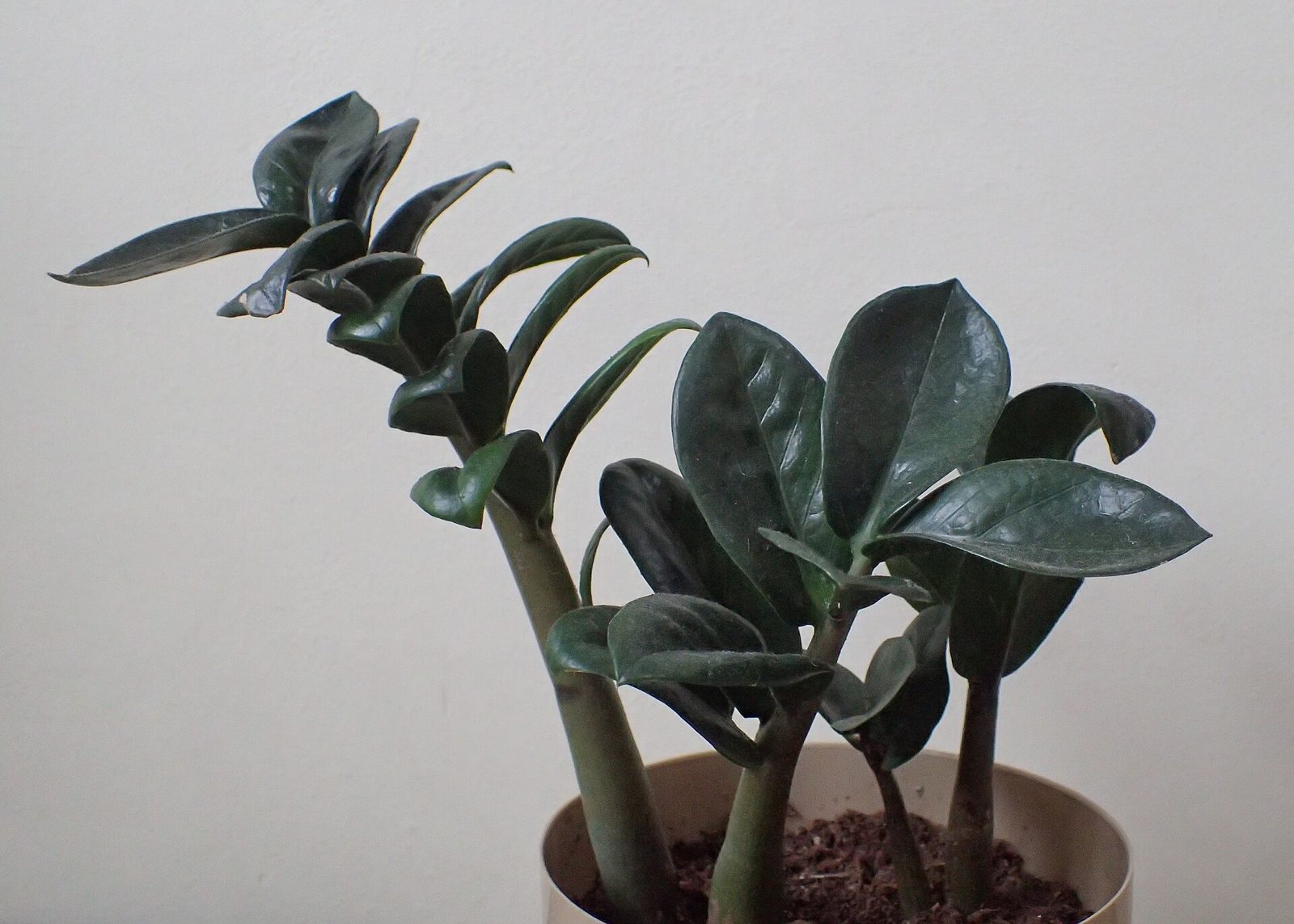
None of the extension sources we use has a section on yellow ZZ plant leaves, so we cannot give you a symptom-to-cause chart. What they do document are the conditions that damage the plant: root rot from too much water, leaf drop in drought, scalding in direct sun, cold injury and pests. Check those in that order. This guide sits under our main ZZ plant care guide.
We would rather tell you what is sourced than guess at a yellowing pattern.
1. Water and roots
Root rot is the best-documented problem. UF/IFAS EDIS says: “Root rot may occur if ZZ plants are grown in poorly drained soil with excessive water for an extended period of time.” Clemson says “overwatering can lead to root rot.” NC State says the plant should be “watered routinely but allowed to dry out between waterings, as wet feet are not tolerated.”
To check: slide the plant out of its pot if you can and look at the mix and roots. Our sources do not describe what a rotted ZZ root looks like, so use your judgment. If the mix is soggy, the pot has no drainage hole or the soil has stayed wet for weeks, fix that first. UF/IFAS EDIS says any well-drained peat- or bark-based potting soil can be used.
How often is too often? The sources differ. NC State says about once a month in winter and up to twice a month in summer, and only when the soil has dried out completely. Illinois Extension says once a month in fall and winter. UF/IFAS Gardening Solutions says the plant will perform better with moderate watering every week or two than with drought. All of them require the soil to dry between waterings.
2. Drought
The opposite problem is documented too. UF/IFAS EDIS says the ZZ is “very drought tolerant, although leaf drop may occur.” In drought, it says, leaflets and the upper part of the petiole fall off, leaving the swollen petiole base to tide the plant over until the next watering. So a plant that has lost leaflets but has firm, swollen stalk bases may be dry, not rotting. The sources do not say whether the lost leaflets turn yellow first.
3. Direct sun
NC State says “scalding and browning of leaves can occur if the plant is placed in direct sunlight.” Clemson says to locate ZZ plants “anywhere except in full sunlight,” and UF/IFAS EDIS says strong, filtered light but no direct sun. If you recently moved the plant to a brighter window and the leaves have changed, think about that before you blame the roots. Scalding and browning is the sourced description, not yellowing, so we do not claim sun causes yellow leaves.
4. Cold
Clemson says ZZ plants are sensitive to cold and should be kept above 60°F. UF/IFAS EDIS says active growth will be reduced and injury may occur below 50°F, with no freeze tolerance. A plant on a windowsill in a cold winter room, or near an exterior door, is worth moving. The sources do not describe what cold injury looks like on this plant.
5. Pests
Illinois Extension says to “regularly check ZZ plants for signs of pests such as aphids, mealy bugs, thrips, and whiteflies.” UF/IFAS EDIS says no diseases or pests are an issue. We cannot reconcile the two. Check the undersides of leaves and the stalk bases when you water. Our sources give no treatments, so we do not either.
What to do next
- Check the mix and the roots. Is the mix wet at the bottom? Is the pot draining? Wet feet are not tolerated (NC State).
- Let the soil dry fully. All sources require it between waterings. Then follow a cautious interval from NC State or Illinois Extension.
- Look at the light. Move the plant out of direct sun (NC State, Clemson, UF/IFAS EDIS).
- Check the temperature. Keep it above 60°F (Clemson) and away from cold windows.
- Look for pests. Aphids, mealybugs, thrips and whiteflies are Illinois Extension’s list.
What our sources do not tell you
Nothing in these sources says what a yellow leaf means, which leaf to cut or how to tell rot from drought by color. If the plant keeps declining, take it to your state extension office or master gardener helpline with a photo. Back to the ZZ plant care guide, or see how to propagate a ZZ plant if you want to save a healthy piece.
Frequently asked questions
Why are my ZZ plant leaves turning yellow?
Our sources do not give a yellow-leaf diagnosis. They do document root rot from poorly drained soil with excessive water (UF/IFAS EDIS), overwatering (Clemson), scalding and browning in direct sun (NC State), cold injury below 50°F (UF/IFAS EDIS) and pests (Illinois Extension).
Can overwatering kill a ZZ plant?
Clemson says overwatering can lead to root rot, and UF/IFAS EDIS says root rot may occur in poorly drained soil with excessive water over an extended period. NC State says wet feet are not tolerated.
Why is my ZZ plant dropping leaflets?
UF/IFAS EDIS says leaf drop may occur in drought: leaflets and the upper part of the petiole fall off, leaving the swollen petiole base. NC State says too much water is also a risk.
Do ZZ plants get pests?
Sources disagree. Illinois Extension says to check for aphids, mealybugs, thrips and whiteflies. UF/IFAS EDIS says no diseases or pests are an issue.
Sources
- ENH1219/EP480: Florida Foliage House Plant Care: ZZ Plant, University of Florida IFAS Extension (EDIS)
- ZZ Plant (Zamioculcas zamiifolia): Indoor Care and Growing Tips, Clemson Cooperative Extension, Home and Garden Information Center
- Zamioculcas zamiifolia (ZZ Plant), NC State Extension Plant Toolbox
- Houseplant spotlight: the ZZ plant, University of Illinois Extension (Good Growing, January 9, 2026)