

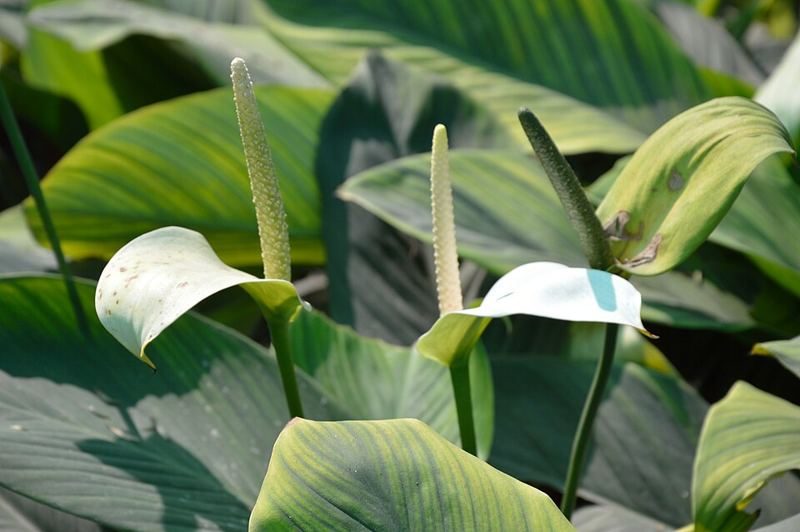
A peace lily does not need frequent repotting: Clemson says it likes to be slightly pot-bound, and the sign to act is roots growing through the drainage holes or circling on top of the soil. When that happens, move up by one to two inches in pot diameter and use a well-drained potting mix. This page covers the sourced details. It sits under our peace lily care guide.
When to repot
Clemson says peace lilies like to be slightly pot-bound, but it is time to repot if roots start growing through the drainage holes or circle on top of the soil surface. That makes the plant itself the calendar. Clemson gives no fixed interval, so there is no sourced “every two years” rule for a peace lily.
UF/IFAS Gardening Solutions says to propagate a peace lily by division in the spring, so spring is a sensible time if you want to split a crowded plant as well as pot it up. The sources do not name a best season for ordinary repotting, and we will not invent one.
Choosing the pot
Clemson’s rule is to choose a container just one to two inches larger than the original pot. It gives the reason too: using too large of a pot may keep the potting mix too wet, leading to root rot. This ties into the main peace lily risk, because the plant wants moist soil that is never soggy. Our reading is that extra soil with no roots to use the water is what stays wet, so resist the urge to jump up several sizes.
Clemson points to drainage. It mentions drainage holes and says to never let the plant sit in a saucer of excess water after watering, because that leads to root rot. So pick a pot with holes, and empty the saucer.
Choosing the soil
Clemson says peace lilies will flourish in almost any well-drained potting mix. UF/IFAS EDIS gives a more specific preference: a rich, organic, peat- or bark-based bagged potting soil. Either fits the same idea, which is a mix that holds some moisture and also drains. Our sources do not name a brand or recipe.
How to repot
- Lift the plant out and look at the roots. Roots through the drainage holes or circling on the surface are Clemson’s signs that it is time.
- Choose a pot one to two inches larger. Clemson says a pot that is too large may keep the mix too wet (Clemson).
- Fill with a well-drained mix and set the plant at its old depth. A peat- or bark-based bagged potting soil (UF/IFAS EDIS) or almost any well-drained mix (Clemson).
- Water, let it drain and empty the saucer. Never let the plant sit in a saucer of excess water (Clemson).
What a pot-bound peace lily looks like
The two signs Clemson gives are both visible without unpotting the plant: roots coming out of the drainage holes, and roots circling on top of the soil surface. Clemson describes the plant as liking to be slightly pot-bound, so a snug root ball on its own is not a reason to repot. Wait for the signs. If a plant that was fine starts to wilt between waterings, roots filling the pot is one possibility to check, though our sources do not make that link.
Dividing a crowded plant
UF/IFAS Gardening Solutions says to propagate your peace lily by division in the spring. The source gives no steps. A clump that has outgrown its pot and keeps filling it with roots is the usual candidate, but the sources do not say how many shoots each division needs or how to separate tightly bound roots. Move cautiously, and keep roots and leaves together on each section.
After repotting
Keep to the same care as before: bright, indirect light and no direct sun (Clemson, UF/IFAS EDIS); soil kept moist but not soggy. If you plan to feed the plant, Clemson says one-quarter strength every six to eight weeks in spring and summer, while UF/IFAS EDIS suggests a low dose three times a year. Our sources do not say whether to hold off on fertilizer right after repotting.
What our sources do not tell you
The sources do not give a repotting interval, a pot material preference or a way to recognize a rotted root. They also do not say whether a repotted peace lily will go through a period of drooping. If the plant declines after repotting, work through our yellow leaves guide, or ask your state extension office. Pets matter here too: the ASPCA lists the peace lily as toxic to dogs and cats, so keep soil and trimmings out of their reach (see our pet safety page).
Frequently asked questions
When should I repot a peace lily?
Clemson says peace lilies like to be slightly pot-bound, but it is time to repot if roots start growing through the drainage holes or circle on top of the soil surface.
What size pot does a peace lily need?
Clemson says to choose a container just one to two inches larger than the original pot. A pot that is too large may keep the potting mix too wet and lead to root rot.
What soil is best for a peace lily?
Clemson says peace lilies will flourish in almost any well-drained potting mix. UF/IFAS EDIS prefers a rich, organic, peat- or bark-based bagged potting soil.
Can I divide a peace lily when I repot?
UF/IFAS Gardening Solutions says to propagate a peace lily by division in the spring. It does not give steps, so use care and keep roots with each section.
Sources
- Peace Lily, Clemson Cooperative Extension, Home and Garden Information Center
- Peace Lily, University of Florida IFAS Gardening Solutions
- Spathiphyllum (EP477), University of Florida IFAS Extension (EDIS)