

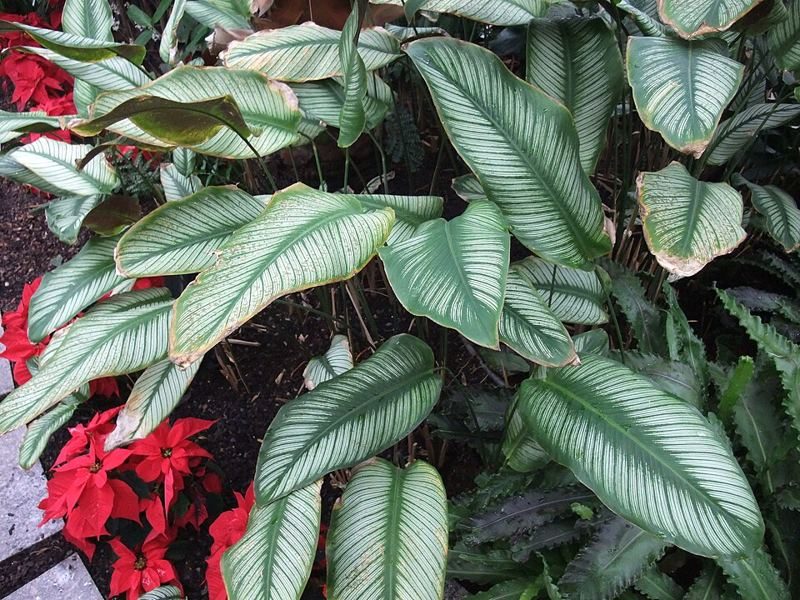
Calatheas prefer bright, indirect light or partial shade, and NC State says direct sunlight burns or damages the leaves. The sources are four species profiles, so this page names the species each time. The rose-painted calathea “prefers bright, indirect light,” the network prayer plant “prefers partial shade,” and the Alberta prayer plant’s leaves are damaged by direct sun. It supports our main calathea care guide.
What each species page says
Rose-painted calathea
Network prayer plant
Majestic prayer plant
Alberta prayer plant
Reading the pages together
The sources do not use a single word for the right light level. “Bright, indirect” and “partial shade” are not identical, but they overlap in a bright room where the sun does not strike the leaves directly. NC State is clear about what to avoid: direct sun. Two pages say so, with “leaf burn” on one and “damage” on the other.
The majestic prayer plant’s page gave no light preference in our research, so we have no sourced light level for it. A reasonable guess is that it is similar to its relatives, but that is a guess.
What this means for a window
Our sources do not name a window direction. We can translate “bright, indirect” into a position, but it is our translation, not NC State’s:
- a few feet back from a south or west window, where the light is bright but the sun does not hit the leaves
- beside an east window, where morning light is gentler
- behind a sheer curtain in a window that gets strong sun
A bright north window may also work, but our sources do not say. If the leaves look burned or faded, move the plant back from the glass, since NC State names direct sun as the cause of leaf damage.
Light is not the only part of the spot
Calatheas are more particular about humidity and temperature than about window direction, and the same pages that name the light also set the environment.
- Humidity: at least 60% for the network and majestic prayer plants and up to 60 to 70% for the Alberta prayer plant. For the majestic prayer plant NC State suggests placing the container on a bed of wet pebbles or growing it in a humidified room.
- Temperature: 65 to 75°F (rose-painted), 60 to 80°F (network) or 65 to 80°F (majestic).
- Drafts: the network prayer plant is intolerant of sudden temperature changes and drafts. A bright window that is cold at night or beside a vent is a risk.
A sunny window that is cold and dry in winter may therefore be the wrong place, even if the light is right.
Signs the light is wrong
Our sources describe only one light-related symptom: leaf burn or damage from direct sun. NC State does not describe what too little light looks like for any of the four species. It also lists brown leaves and tips as a result of low humidity or fluoride in tap water, so brown tips are not evidence of too much light. Check the humidity and the water first.
How to choose a spot
- Start bright but indirect. That is NC State’s wording for the rose-painted calathea.
- Keep direct sun off the leaves. NC State says it burns the network prayer plant and damages the Alberta prayer plant.
- Check the humidity. At least 60% is the figure for three of the four species.
- Avoid drafts and vents. The network prayer plant is intolerant of sudden temperature changes and drafts.
What our sources do not tell you
We have no foot-candle figure, no window direction, no light level for the majestic prayer plant and no description of low-light symptoms. For the care routine, see the calathea care guide. To see how a different plant handles the same bright-window question, read the monstera light section.
Frequently asked questions
Can calathea take direct sun?
No. NC State says direct sunlight can cause leaf burn on the network prayer plant and will damage the leaves of the Alberta prayer plant.
Does calathea grow in low light?
Our sources do not recommend low light. NC State says bright indirect light for the rose-painted calathea and partial shade for the network prayer plant.
What temperature does calathea need?
NC State gives 65 to 75°F for the rose-painted calathea, 60 to 80°F for the network prayer plant and 65 to 80°F for the majestic prayer plant.
How much humidity does calathea need?
At least 60% for the network prayer plant, 60% for the majestic prayer plant and up to 60 to 70% for the Alberta prayer plant (NC State).
Sources
- Goeppertia roseopicta (rose-painted calathea), NC State Extension Plant Toolbox
- Goeppertia kegeljanii (network prayer plant), NC State Extension Plant Toolbox
- Goeppertia majestica (majestic prayer plant), NC State Extension Plant Toolbox
- Goeppertia albertii (Alberta prayer plant), NC State Extension Plant Toolbox